
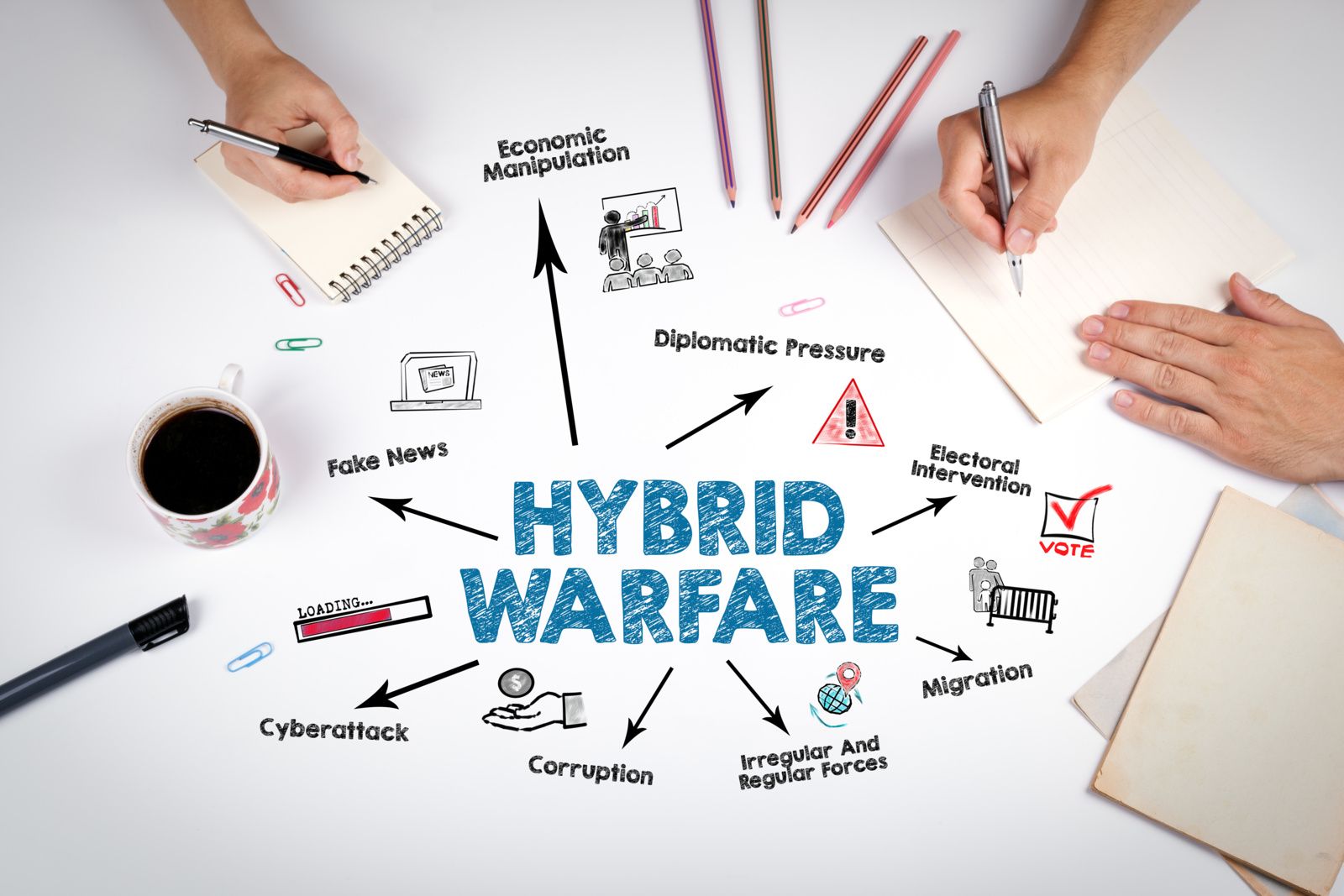
The concept of “hybrid warfare” emerged some ten years ago and has taken on particular relevance with the Russian invasion of Ukraine. But even though the subject is a burning one, one major part of our daily lives is often absent from the reading and conferences on it: companies… And you – how far could you go with yours?
Hybrid warfare? There are several definitions of this type of confrontation, and many of them are probably accurate, for a situation that is multifaceted by nature. To put it briefly, let us say that it is a confrontation that is, a priori, “below the threshold”: that of war as a clash of arms, one army against another. But it can precede, accompany or follow such a war…
This kind of confrontation interests many audiences: the military, of course, diplomats too, and researchers in the strategic field. Some journalists and specialists in information and knowledge warfare as well. But few representatives of companies, which seem to be the great absentees. Forgotten, or unknown? Probably all of these at once.
So what are the strategies and room for manoeuvre of private actors in these “hybrid” conflicts? Those who, a priori, do not rely on gunfire (unlike “militias” or “private military companies”), but prepare such conflicts, support them or render them ineffective? What legitimacy do they have? What autonomy of decision and action? What synergies, acknowledged or not, with public authorities?
The temptation, of course, for this new domain of “sovereignty”, is to strengthen the role of the State. But is that really the only way, when we want to defend, through conflict, the values of our democratic and liberal societies against authoritarian or even totalitarian regimes? Can we give up our principles of freedom of individual and private action, of diversity and of the balance of powers, in the name of an “efficiency” that has yet to be demonstrated – and above all at the risk of losing the meaning of our commitment? Thereby handing our adversaries and enemies arguments about the relevance of our values and institutions?
In cyberspace: companies and sovereignty
There is one field in which specialists recognise the importance of companies: information and perception warfare. Both for content and for its carriers.
In the age of TV packages, smartphones and the internet, information is everywhere. And everyone complains about (the other side’s) “disinformation”. So while some are content to choose their channel and recommend it, others argue and act for certain channels to be shut down. A difficult choice in our liberal and democratic societies, when what is at stake is not directly punishable by law. This is the recurring question of whether or not to deprive the “enemies of freedom” of freedom. A vast subject… And in any case one that concerns a multitude of private actors, often perceived – or even accused, it should be noted – as agents of disinformation, or at least of poor information, because of their “non-public” status (for public actors, it is seen as “fair game”). Initiatives such as the Association des journalistes de Défense (the French association of defence journalists), which has existed since 1979, aim to foster quality information on these subjects, while seeking to maintain the balance of “independence”. But it is not an easy quest, as the recurring controversies over “embedded” journalists (integrated into military units) show.
As for the “carriers” (because even the cloud relies on physical infrastructure), the role of companies is closely linked to the question of sovereignty. The question of the submarine cables that carry information has been raised recently. And of course, at the heart of the news about the invasion of Ukraine, there is the use of Western air and space assets in support of the Ukrainian forces. But also – and this goes beyond the anecdotal – the provision of the Starlink system by SpaceX, Elon Musk’s company, which has allowed the Ukrainian forces, and citizens, to maintain independent communications and thus relay valuable information from right on the ground.
Synergies in the service of operational innovation
Beyond the example of Starlink, there have often been many opportunities for freely agreed synergies between the State, which holds the legal monopoly on force, and private companies working in the field of information.
At the start of the Russian invasion of Ukraine, there was talk of the effectiveness of the Aerorozvidka unit, which used very light drones – and civilian operators who were more “geeks” than gung-ho soldiers – to support targeted commando action. Then came images of adaptations that made it possible to drop grenades…
In 2010, the French company Parrot launched its first leisure drones. Since then, their use has been regulated and they are now mainly used professionally. And yet, as soon as they came onto the market – while these little machines did indeed raise fears of voyeurism within everyone’s reach (hence the regulation) – they gave their owners the possibility, notwithstanding their very limited range at the time, of looking over to the other side of the hill without risk…
And fortunately, over time, synergies regularly arise from the meeting between civilian tools and the needs of the armed forces, enabling innovations such as those presented at the Sofins show (dedicated to special forces equipment) or, more generally, through the activities run with companies of the BITD (the French defence industrial and technological base). But in the event of a “hybrid war”, would we know how to use the equipment and skills of private actors alone?
The war of perceptions and of daily life
In these situations, we are, a priori, in a field that is more operational than cognitive or “environmental”. And therefore far from hybrid warfare…
Yet when it comes to actions “below the threshold”, companies also have other means of action – and as many responsibilities.
Take, for example, the decision to open or close a factory or shop in a given country. Beyond the economic stakes (the opportunities but also the risks) borne directly by the company, its decision has a direct impact on the society in which it sets up, in many ways.
Through the products it makes or distributes, the jobs it offers, the skills it brings to the local workforce, the wealth it distributes through local taxation. A “taxation” which may, incidentally, be illegal under our own rules, or at least immoral… This touches on a whole range of the company’s responsibilities, through its organisation and management practices, to promote – or not – the principles of our liberal and democratic societies in the daily life of “civil society”. And therefore to act on the other side’s society. Are we not here in the field of “hybrid action”?
And since “hybrid warfare” can accompany “classic” warfare, but also precede or follow it, these political and moral dimensions are at the heart – consciously or unconsciously – of the decisions of companies’ “governance”, but also of their representatives, right on the ground. Because it is in daily life that the values we hold are embodied, or not[1].
Making companies allies in hybrid warfare
From discussions with specialists in hybrid warfare, it emerges that companies are largely ignored in thinking on the subject, and therefore probably in action.
Some “justify” this absence by a multitude of obstacles. Let us mention a few, and suggest some answers.
“What motivates companies is profit.” Of course. Because profit makes it possible to invest, to develop both skills and tools, to create jobs and wealth. But beyond this cliché, the statement reflects both a hasty generalisation of a one-sided perception and a lack of knowledge of the realities of companies. Because companies are not anonymous organisations, but above all men and women who take decisions. Every day. And while people sometimes debate whether or not to separate “the man from the artist”, one cannot reasonably believe that a company’s decision-makers completely set aside, when they act, their individual perceptions of the world, their beliefs, their convictions. They never abandon them entirely, nor do they submit to them. It is always a matter of compromise. Between the “rational” and the “irrational”. And this delicate balance can lead them to commit themselves, and their company, for reasons that have nothing to do with economic profit alone.
“Companies have international shareholders.” Some do, indeed. There are two answers to this objection. The first is to take into account the strategic alliances that bind States. Because if States commit their military resources together, why couldn’t companies and their decision-makers do the same? The second concerns the consistency of strategic choices – those of States and of companies. Because how can one imagine that an authoritarian or even totalitarian country (in which, therefore, companies are subordinate to politics), with which economic agreements binding companies are concluded, will not use them, when the time comes, to influence strategic decisions?
Of course, this requires the ability to define and share a strategic vision that is as clear as possible, in a world that is uncertain by nature. Because everyone can only be mobilised in support of an acknowledged project. Shouldn’t we act here too, through clarification and sharing, or even debate, rather than considering it a “reserved domain”?
And what about risk?
Another objection one hears is the “risk aversion” of our societies (and therefore of our companies).
In a field shared with State actors, this probably refers to the nobility of the commitment of public actors, and in particular those involved in military action. Certainly. But while there is no question whatsoever of downplaying the exceptional nature of some people’s commitment – to the very end of the mission, at the risk of their lives – it should not be forgotten that this does not concern all of these actors. And that while some commit for this reason, and take these risks in their roles, there are also other motivations, just as respectable, and other roles, much less exposed.
Above all, it ignores the relationship with risk that entrepreneurs know, whether they work in companies or for themselves. Of course, it very rarely involves risking their lives – though, when the risks taken, or real or perceived “social death”, drive some to desperate acts…
But through the risks to their social standing (what recognition does the entrepreneur get?), to their economic balance (in the absence of a guaranteed “salary” and pension schemes), and to the balance between professional and private life (which many personnel in highly committed units also know), shouldn’t we recognise that economic decision-makers also take real “risks”? It is true – and this may disqualify them in the eyes of some – that risk-taking is sometimes rewarded, in the end, with tangible benefits. But why not, if a “win-win” approach is adopted in these hybrid operations?
Finally, when it comes to risk, there is another area that may frighten some companies but also motivate others to increase their synergies with the collective interest, and therefore with the State: the risk of possible accusations of “war crimes”[2], in theatres of armed conflict but also, more often, in situations of hybrid confrontation. Here, it is important to give them the benefit of the doubt as to their intentions – or at least to recognise their lack of awareness of strategic issues. Particularly when these issues are little or not at all explained and shared by the State. Or when they “shift”, depending on the opportunities perceived by sometimes inconstant leaders. While it is important to remain vigilant about the separation of powers – one of the cardinal virtues of our societies – and therefore about the possibility of punishing breaches of the common law, particularly where there is proven intent, these situations clearly show the need to consider companies’ actions as a major vector of hybrid confrontations.
One caveat on this subject, however: we should not assume that the only way is to subordinate the company to politics, as a guarantee of “control” and, by implication, of “virtue”. Because, once again: what are we defending? If it is a model of democratic and liberal society, we must prefer synergies to constraints – except those provided for by known and shared laws. Otherwise, what distinguishes us from “illiberal democracies”, or even from authoritarian, if not dictatorial, regimes built on direct or indirect control – through the law, coercion or compromise?
Who should take charge?
Finally, “who should take charge?”. A big question which may, unfortunately, and beyond a simple matter of common sense, reflect one of the recurring ills of our public organisations. Namely the temptation to gain “domination” over the other at all costs, rather than to consider cooperation with them… And many of us may have in mind examples of situations that could be summed up by the following view: “if I’m not the boss, it won’t happen”. Here, the practice of business people could no doubt be useful to a joint approach, since they are so often led (sometimes forced, admittedly) to cooperate, even with competitors, when market conditions require it.
And in the field of “hybrid warfare”, we can also look to our recent history for ideas about who might “carry” such joint action.
Thirty years ago, Europe was already experiencing a war on its territory, in the Balkans. At the same time, France was setting up its Special Operations Command (COS) – which is currently celebrating its 30th anniversary. Perhaps it was because these innovators were the most curious about those unusual actors, company decision-makers… but General Saleün, who would take command in 1996, had launched an effort to raise awareness among entrepreneurs likely to work in that still “devastated” theatre of operations. In particular through the networks of “reservists” – at the time, no distinction was yet made between “operational” and “citizen” reservists. And notably those with responsibilities in construction and civil engineering companies. Because this was not yet the age of “information warfare”, and the physical field was the most familiar.
Perhaps it was also because this new command enjoyed, at least while it was being set up, “room for manoeuvre” that conventional forces could not obtain. In particular in the face of the “veto” of the Foreign Ministry (and no doubt others), which considered that while the French forces’ mission was to commit militarily, they should keep away from questions of economic profit – including for national companies. Other countries involved did not share the same reluctance, or even aversion[3].
And this observed lack of synergies obviously brings to mind, for that period and place, the fact that the reconstruction of Sarajevo airport, located in the French sector during the peace stabilisation operations, had brought only an 11-million-franc contract to Thomson-CSF… Perhaps it was also a lack of enthusiasm on the part of French companies: “In 1996, as regards European programmes, of the 227 million ecus committed, 74 concerned supplies; 102 French companies were approved, 27 submitted a bid and 9 won contracts for a total of 4.9 million ecus, i.e. 6.5% of the total, compared with the 22% achieved by Italy.”[4]
Since then, after this first sketch of a willingness to act differently, France has gone down the road of “civil-military actions” with the GIACM (the French joint civil-military action group). Over time, these have become exclusively actions on the environment in support of the forces[5], with the creation in 2012 of the joint centre for actions on the environment (CIAE), which operates in the field of perceptions and influence.
Here again, a purely “informational” field. Which is no small thing, but is not everything. Because, once again, the presence of companies is, in the context of hybrid confrontation, a lever that can be used in many fields.
So, to the question of “who takes charge”, I would venture to suggest: those who want to, because “necessity knows no law” and, in this field, abundance is not to be feared… There will always be time, if need be, to manage the necessary synergies. Which is more virtuous than noting an absence.
Getting to know each other better in order to work together better
In conclusion, it appears that many of the obstacles perceived or expressed by those currently waging wars whose hybrid character is growing – along with the share of the unknown that comes with it – are above all linked to the public sector’s profound lack of knowledge of the business world, especially in the part of it endowed with sovereign prerogatives.
There is probably something akin to a “cultural transformation” at stake… Something that affects both organisations and the people in them. And which takes place over the long term – but do we have that time?
So, for now, there are many actors who could contribute to a mutual “taming”, and to very concrete actions.
There are, for example, the “dinosaurs” of compulsory national service. As time has passed and experience has been gained, some of them now hold positions of responsibility in many companies. Some had joined the reserve. Few are probably still there, given the reduction in the size of the armed forces and the age pyramid. But some have no doubt kept a closeness to, or at least an interest in, military matters.
There are also purely voluntary “reservists”. Whether operational – and involved in company life alongside their military commitment, not in a “second career” (which takes nothing away from their merit but does not make them “hybrids”). Or “citizen” reservists who are still professionally active. These are, by definition, what sociologists call “marginal secants”. Because they belong to both social groups and are thus perfect “hybrids”.
But these reservists are most often employed in support of the forces, in a purely “military” role, replacing or reinforcing their active-duty comrades, and in which they are asked, explicitly or not, to forget their civilian characteristics. Why not, on the contrary, take advantage of this “different” perspective to devise innovative approaches suited to hybrid conflicts, which call for skills and levers that are not directly military?
And then there are all those civil society actors in whom the military institution invests through information and training programmes, such as those of the IHEDN (the French Institute for Higher National Defence Studies) or the civilian students of the École de Guerre (the French joint staff college) or the École de Guerre Terre (the Army staff college). Or to whom it opens the events of research bodies such as IRSEM (which held a half-day study session in early June precisely on “hybrid warfare”), or offers the journal Inflexions, a meeting place for civilians and the military.
But in all these useful actions, one sometimes has the feeling that priority is given, as in the operational field, to “actions on the environment”: those that make the specific features of the military and strategic world better known and understood.
What if, to prepare for hybrid approaches, we took advantage of all these many interactions to encourage – like the “reverse mentoring” that company leaders practise with their youngest employees – those in the world of strategic action to discover and better understand how business people work and what motivates them?
Because working together better always begins with getting to know each other better. And while there was talk some time ago of “global defence”, a hybrid confrontation is also, by nature, global.
[1] On this subject, see the article on “corporate Putinism”
[2] « Entreprises et crimes de guerre : nouveau champ de bataille des juges ? » (Companies and war crimes: a new battlefield for judges?), Les Echos, 3 June 2022 (in French)
[3] For example, in Les Echos of 4 April 1996: « L’avion transportant le secrétaire américain au Commerce s’écrase dans les Balkans » (Plane carrying US Commerce Secretary crashes in the Balkans) (in French)
[4] Information report on behalf of the French Senate Committee on Foreign Affairs, Defence and Armed Forces, following a mission to Bosnia and Herzegovina from 8 to 11 May 1997 (in French)
[5] See for example the article in Inflexions, « Les actions civilo-militaires : une finalité opérationnelle » (Civil-military actions: an operational purpose) (2007) (in French)
Leave a Reply