
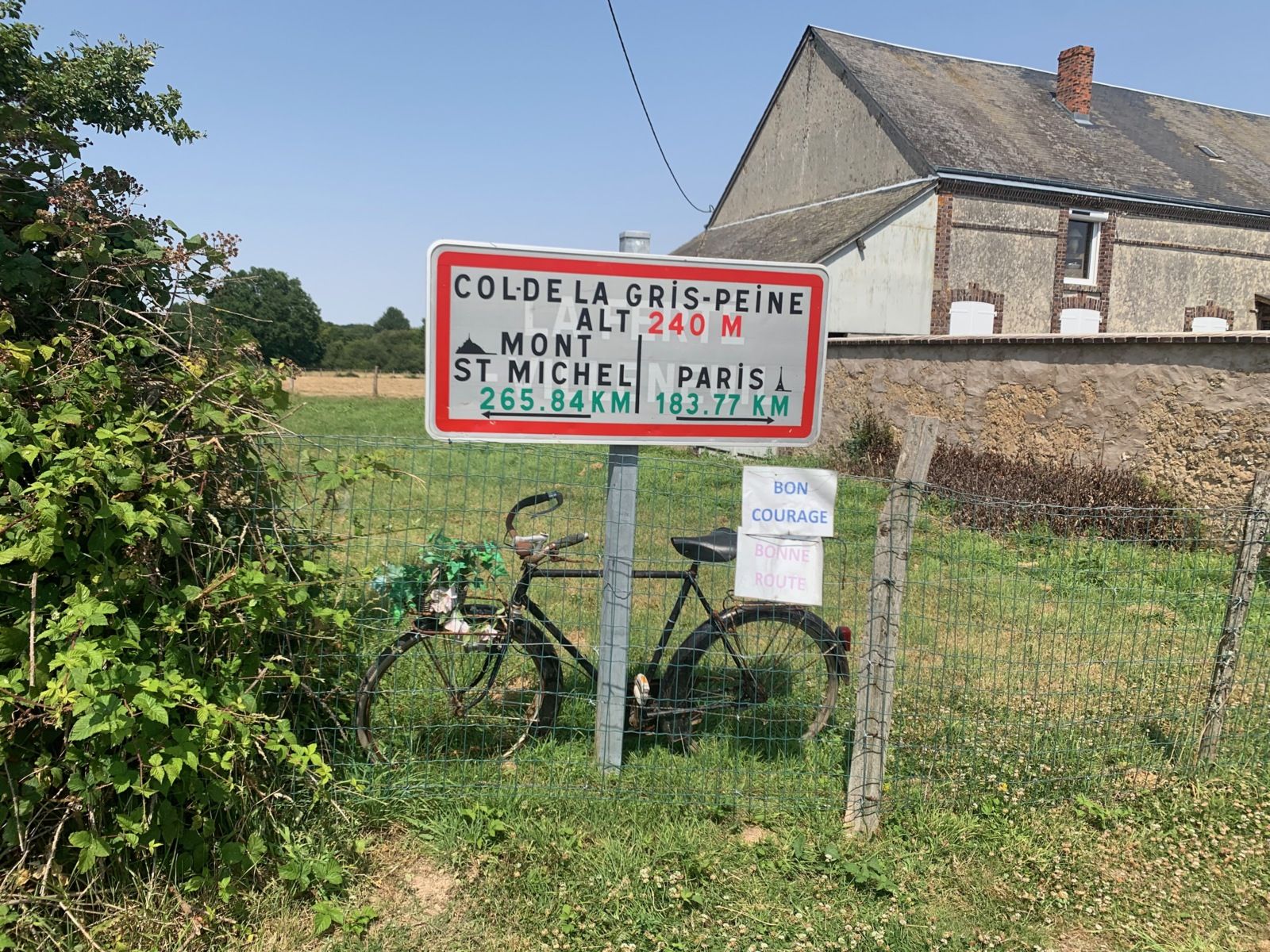
This summer, as last year, I spent a few days on a cycling tour. And very quickly – occupational hazard – I found myself looking at the “customer experience”, convinced that synergies need to be created or strengthened to encourage this kind of trip and, in turn, to make the territory more attractive. With the collective successes of the Brittany TGV Club in mind…
A rich offer
Cycle touring is in vogue. With the growing use of bicycles, especially in big cities, and the spread of electric-assist bikes, more and more everyday cyclists are thinking of trying a leisure activity once reserved for enthusiasts.
Familiar with their mount and sensitive to the issues of soft mobility, city dwellers are looking beyond their usual journeys. And electric assistance is encouraging older people and less sporty riders to consider new “adventures”.
Many association and commercial websites also offer advice on equipment. And manufacturers are showing commercial creativity, such as the recent launch of “gravel” bikes – positioned between city bikes and mountain bikes and therefore promoted as perfectly suited to hiking trails… (in my view, a “non-competition” mountain bike does the job for every use).
And beyond the bike, there is the cyclist’s clothing… because at several dozen kilometres a day, what the amateur considers “superfluous” may turn out to be indispensable.
To practise this activity – chicken or egg? – routes are flourishing and are promoted with maps and guides in the cycling sections of shops. And of course on a multitude of websites and platforms, pushed by local authorities, by companies that are not always clearly identified and/or fed by users. And there is also the option of becoming the tour operator of your own route, with a hiking map or your usual navigation tool.
Dedicated labels (such as “Accueil Vélo”, a French “cyclists welcome” label) are flourishing, reassuring cycle tourists about the welcome they will receive, and thus influencing their choice of route.
And subsidies, such as those from ADEME (the French ecological transition agency), support public (mainly) and private (a few) operators in their investments…
In short, plenty of ingredients, a priori, to encourage the development of this leisure offer.
And yet, between the laudable intention and successful implementation, there is still some way to go…
Of course, some companies have taken into account many of the areas for improvement mentioned here – with bike hire, accommodation booking and luggage transfer every morning. But not everyone can afford, or wants, such “turnkey” services.
The question of trains
A first criterion to consider when choosing your route: how accessible it is from home. Because unless you do a loop from your home, or from a starting/finishing point you reach by car – which in practice limits the destinations available and does not suit city dwellers, who increasingly do without a car – you will have to choose a destination to reach and/or return from by taking your bike on the train.
And that is where the difficulties begin. Because unless you have a folding bike, which by nature is not suited to long cycle-touring trips, the options quickly narrow.
First of all, let us cut short the usual urge to bash SNCF – because when it comes to trains, people quickly think of the “great culprit” the French national railway must be.
So, if one prefers looking for culprits to looking for solutions (you can guess my preference), the search must be widened beyond the national rail company.
Because it is all about practices and rolling stock. And railway rolling stock – of which we are indirectly shareholders, through SNCF or the Regions – is both expensive and long-lived: about thirty years.
France chose to develop the TGV, and we can be proud of this network and these services, which bring territories closer together. But TGV carriages are designed above all for individual passengers.
From the design stage, there are a few spaces accessible to wheelchairs, and these spaces should not be used for a bike, to the detriment of the people concerned. On Eurostar, a compartment probably designed for small-scale logistics made it possible, until the Covid crisis, to take a few bikes (it is still possible between Brussels and London, but not for Paris). And on some TGV trainsets (those with the second-class area at the end of a first-class carriage), the operator has removed seats to allow two bikes on board – which makes four spaces per train for double trainsets…
Of course, there is more than the TGV. And the return to service of “Corail” carriages on conventional routes made it possible, when they were refurbished, to offer spaces to hang your bike – provided you can lift it up from the platform…
As for regional TER trains, the most recent ones make it easy to load bikes on board – with a reservation, which is understandable to avoid overcrowding, but which sometimes requires some planning on popular routes.
So why so many difficulties?
Quite simply because the demand is very recent. And, as mentioned above, rolling stock is not replaced every year… Not to mention that, outside the high season for cycle touring – and during it too – there are “conflicts of use” between those who want to take their bikes and those who simply want to travel, while the number of spaces is limited for safety and comfort reasons.
So, if we must look for culprits (when it is always more useful to look for solutions), we might as well say “everyone is guilty”, including the French themselves: those who discovered cycle touring too late, or those who do not practise it enough. And at this usual game, we will all soon be losers…
For my part, living in Paris, last year I chose Mont-Saint-Michel as my destination, returning on a TER… a TER in great demand among cycle tourists, some of whom, having not booked, had to stay on the platform at Pontorson station with their bikes.
This year, I took TGVs heading east both ways, starting in Nancy and returning from Colmar.
But next year?
Which route? Can abundance be a problem?
On the ground, routes are often numerous, and sometimes compete with each other.
There are association-run routes, more or less supported by local authorities (because by nature, a local authority’s support stops at its boundaries). You may come across them while searching online, or discover them on the spot.
And then there are more institutional routes, such as “véloroutes” (long-distance cycle routes), which complement them – or not… And take you on a detour that is sometimes charming but unplanned. Routes run by local authorities whose territories sometimes overlap… the French institutional layer cake applied to cycle-touring routes[i].
And then there are the routes suggested by apps such as Google Maps or Geovelo, for example. With sometimes surprising settings (I am thinking of the former) that may lead you, with a loaded bike, onto a “single track” better suited to trail runners or horse riders than to laden cycle tourists…
Not to mention those in dedicated guidebooks, which are not necessarily the same as those on the dedicated road maps.
One would have to be fussy to complain about such abundance… But when, at a fork, you have to choose between the Alsace Wine Route and the Alsace Vineyards Route, because one avoids a village (crossed out on the signpost), you start to wonder – and the stakeholder management specialist may suspect local tensions. Situations that lead to a kind of perplexity, if not dismay…
Or perhaps it is a local “bypass effect” (residents keen on their peace and quiet encouraging the detour with this variant…). Unless it is simply that people forgot to talk to each other… the all-too-classic “silo effect”.
Drinking, eating
One can live on passion, but one also needs fresh water, especially in high summer. For my part, the five litres I carried were barely enough for a day in a heatwave.
We know that water is precious, scarce and expensive. But above all it is often absent from our countryside (and I am not talking about forests where, almost paradoxically, you can find streams – provided you can treat the water).
With fountains closed in villages and absent from new housing estates, finding a drinking-water tap can become, for those who have not planned ahead, a real quest for the Grail (there are certain types of places where you can find them, but I will not name them here, for fear that, once too well known, they will be closed…).
So why this scarcity?
Probably, above all, economic reasons: maintenance of installations and the cost of water. Some may also put forward the ecological argument of responsible consumption. But there, rather than banning and removing these installations, a “nudge” can help. Like a “drinking water” sign on a fresh-water fountain by the sea this summer, which led people to give up washing off their feet sand that would fall off by itself once dry (the water in our toilets is “drinkable” too, but let’s not tell them…).
With this very material constraint, travelling through our countryside can disconcert city dwellers used to finding a supermarket open downstairs, almost at any hour and in any case every day, selling food and drink. In cities, public fountains are, that said, almost as rare, but there is often a commercial solution – which is obviously not satisfactory.
In villages, cafés have closed, as have grocery shops. And out-of-town supermarkets are mostly closed on Sundays and public holidays.
As for restaurants, they considerably increase the cost of the trip. And, for the well-known reasons of recruitment difficulties, they are often closed on Sundays, Mondays and public holidays too, as well as during the summer holidays – which are by nature good times for leisure touring.
Of course, it is always possible to plan ahead and fill your panniers with provisions, or even a stove…
But then, indirectly, the question arises of how tourists who do not “consume” enough are welcomed and served. Tourists for whom people would not wish to renovate, let alone create, mobility infrastructure and associated services.
As regards water, I noticed that some fountains had been closed – after a much-noticed experiment in making one fee-paying, probably abandoned because of the specific maintenance required – because of use by camper vans, with much larger volumes than a hiker’s water bottle.
From the point of view of local authorities and taxpaying residents, if they take a purely economic view, it is understandable: why accept spending for the territory’s “free riders”?
But conversely, one could ask other public actors about their motivations – like the small Normandy village on the way to Mont-Saint-Michel that offered not only a water point but also perfectly maintained public toilets (another crucial point).
Can public action be reduced to economics? A very topical question, in these times of inflation and pressure on public and private budgets…
Resting, too
Along the same lines, there is also the question of accommodation… Campsite, hotel, bivouac? The comfort you want, availability and price are all criteria that will guide your choice – whether planned or by default.
Because despite the “labels”, there is not necessarily a link between the routes identified and the accommodation available.
The “Accueil Vélo” label in theory guarantees cycle tourists a certain number of services. For professionals, it involves a fee (300 euros for three years, which remains reasonable for an establishment with many visitors). But promotion by tourist offices is often linked to membership of the organisation. Again, an expense some must hesitate to incur.
All the more so since you do not need the label to offer equivalent or even better services – word of mouth on social networks then does the advertising…
The lessons of the TGV Clubs
So, as we can see, the success of such a getaway depends on the action of many stakeholders.
And the point of these lines is not to put you off considering it for your next holiday. But to pay tribute once again to the leaders and contributors of the TGV Clubs, and in particular the Brittany TGV Club, whose principles of action and mobilisation can go beyond the world of mobility and tourism.
The idea of the “TGV Clubs” – “one of the most effective public relations tools SNCF devised around its future TGV services”[ii] – was born in 2004 from a meeting of two things:
- The observation, shared by SNCF and the decision-makers of the local authorities that would benefit three years later from the arrival of the East European TGV, that the mobilisation of the beneficiaries (in particular economic actors) was insufficient, even though the works were already under way… There was therefore a risk that the “return on investment” would come slowly, too slowly, after the line opened. Hence a shared desire to generate more attention, enthusiasm and commitment – even before the first train pulled into the station;
- And principles of action tested on other stakeholder mobilisation projects, in a “non-hierarchical” context – because that is precisely the issue: how to set in motion actors over whom you have no hierarchical leverage…
And in Strasbourg, as business and political leaders jostled to join the “Club” also set up in Nancy and Metz, Guillaume Pepy, then Executive Managing Director, launched the striking and meaningful slogan “Inventing the life that goes with the TGV”.
Because that is exactly what it was about. What is the point of building exceptional infrastructure and high-speed services if the services that would benefit from them did not exist?
As Pierre Messulam – a leading rail systems expert at SNCF, who had decided to bring the dynamic into the Rhine-Rhône TGV project he was running – put it to local authorities and companies: “You want maximum economic spin-offs from the TGV; I want maximum passengers. It’s the same thing. Let’s talk”[iii].
People did not yet talk about “mobility”, but the aim was already to bring into service, at the same time, connecting regional trains, local buses, taxis and pedestrian routes (cycling was still an individual practice back then)… Because what is the point of saving time between two stations if you cannot reach your destination quickly and comfortably?
And then there was the question of welcoming visitors better. As in Strasbourg, where the Chamber of Commerce and Industry would offer shopkeepers foreign-language training to welcome those who would use the TGV to stop off in the European capital. And would more generally mobilise business leaders to build the competitive advantage of the new rail services into their offers, or at least their communication.
Successfully tested with the East European TGV, the TGV Club principle was then built into the Rhine-Rhône TGV project between 2008 and 2011, where its achievements diversified – in Mulhouse, Belfort-Montbéliard, Besançon and Dijon. And its principles of action were refined in the light of successes but also of difficulties (one always learns from difficulties, but one must also keep in mind the conditions for success).
With actions to improve local mobility even before the line opened, despite structuring administrative constraints. Or to encourage local authorities to take up the subject, beyond demands for something in return for public funding.
And the TGV Club principle was deployed even more effectively for the opening of the Brittany TGV, thanks to work carried out between 2012 and 2017 (and even continued afterwards, until the Covid crisis) by the Brittany TGV Clubs (one for each département served by the new line, plus regional coordination).
Here again, local authorities were encouraged to plan local mobility services in good time. But the most significant achievements were seen in tourism. With “turnkey” offers designed through partnerships between SNCF, private operators and the regional authority’s services. And even the trial and then roll-out of the regional “Bretagne sans ma voiture” (Brittany without my car) policy, overcoming tensions over prerogatives between different public actors, in the service of the common interest.
Or again, after the line opened, “job dating” events in Paris, with a same-day TGV return trip, to promote the attractiveness of the region and its companies.
Here again, synergies to be imagined and sensitivities, even rivalries, to be managed – particularly when public organisations considered, in the light of the successes achieved, getting into selling services “boosted” by operating costs already covered by public money…
“Working better together”
I have sometimes been asked what the methodology of the “TGV Clubs” was.
There is no specific methodology, but rather a partnership stance, principles of action and a practice, largely inspired by sociodynamics.
Energy, too, that has to be constantly injected to keep the project alive – and it was SNCF’s choice to leave full autonomy to the Clubs’ participants, while providing them with methodological and operational support.
And above all, women and men of goodwill, at the head of companies and public and private organisations, or in key positions within them. Women and men able to decode the complexities of their organisation, to share its constraints but also its opportunities, and to bring interests together in the service of their territory’s development. Women and men ready to become pioneers, and then ambassadors, of the project. Most of the time on top of their often numerous professional commitments.
This collective goodwill is the real key to the success of a collective dynamic.
Because dynamics often fail for lack of contributors. More than because of obstacles placed in their way (even if, naturally, that happens).
So: bringing private initiatives and public projects together… moving beyond clashes of egos, taking electoral calendars into account and above all freeing oneself from them, identifying the key actors and everyone’s projects in order to imagine and implement synergies… These are some of the rules for taking action.
So many very concrete actions that can be taken to develop cycle tourism and therefore a territory’s attractiveness. And of course other services for our companies and fellow citizens in employment, health, training…
Let’s talk about it!
[i] For example, on the website of the “EuroVelo” label: “The development and operation of EuroVelo routes is carried out by national, regional and local authorities, commercial service providers and NGOs.”
[ii] « SNCF, la fin d’un monopole » (SNCF, the end of a monopoly), François Regniault, Jean-Claude Gawsewitch Éditeur, 2010
[iii] Ibid.
Leave a Reply