

“Resilience” is a keyword used during the crisis generated by Covid-19. And the current trend of “well-being”, like mainstream psychology, have led to the use of this word in the sense of psychic “resistance”, and reconstruction — as for the children who, after a major trauma, continue to live and grow. For others, resilience has been used in the sense of “combat resilience”: how a submarine, tank or plane can “take” blows while continuing its war mission …
Until last summer, I had missed, on this Covid crisis, “organizational resilience” approaches, the ones which inspire modern risk management specialists. People who believe that risk is not managed by “always doing more of the same”. Who nurture the schools of “Resilience Engineering” or “High Reliability Organizations”… These approaches are far more known and implemented in the Anglo-Saxon world than in the French organizations. Even if the “Resilience Engineering Association” is located in a laboratory of Mines Paris Tech.
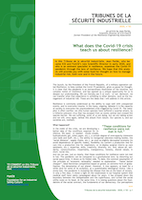
Jean Pariès happily fulfilled this expectation in June, in a paper in French — and in English in September. A specialist in industrial risk management, he published it on the website of the Foundation for a Culture of Industrial Safety (Foncsi), entitled “What does the Covid-19 crisis teach us about resilience?». This paper deserves a wide distribution, beyond the public of specialists. As, with this in-depth analysis, he puts into words the unease many of us experienced, or at least perceived (at least in France), during the last months: the feeling of a public action with no priority, without a clear strategy, in reaction more than initiative, and therefore full of jolts and inconsistencies.
This symptom is often the one of complex systems facing crises that exceed their capacity for “resistance”. As the classic approach to risk management is that of an insurmountable wall, which we raise, reinforce, double, triple, quadruple, with harder and harder measures … even if the wave will, eventually, pass above it or from below or from the sides …
This “classic” approach is the one of zero defects, of the proud fantasy of “zero incidents”, which would prevent “zero accidents”. And when there is an “accident”, this approach look for and find necessarily “culprits”. Excluding the hypothesis that this accident was inevitable, but acceptable.
HRO and Resilience Engineering
Born in the 1970s in the United States, the High Reliability Organizations approach radically renewed the insights related industrial security, especially in complex systems — the seminal study applied to an aircraft carrier, a complex combat system by nature (imagine landing a combat aircraft on a moving aircraft carrier, in the heat of an air-naval system involved in a war situation…).
“Resilience Engineering” emerged some years later, a very close “cousin” of HRO in my opinion — even if it is subject to debate between academics — . This theoretical and applied dynamic works to define the conditions of “resilience” in complex organizations and systems.
Far as I know, there has been only rare “general public” promotion in French of these radically different approaches, except through the work of the ICSI, followed by specialists in risk management, academics and business experts.
Unfortunately. As the proposed change is so drastic that this promotion is done with care, so as not to provoke rejection — as it is a real “paradigm shift”.
Indeed, more than looking for pure and perfect, inviolable and indestructible systems, this approach chooses “system resilience”: “It goes beyond the capacity of a metal, an individual or a society to withstand blows. It is the capacity of a system to maintain or redefine the dynamic equilibria that cause it to maintain a stable state in an unstable environment”.
As even in the case of “ultra-safe” systems (public transport for example), no one can exclude the possibility of accidents: in particular because the additional cost of complexity, procedures, precautionary measures itself generates accidents, when it does not suffocate the system …
At war against oneself?
Applied to the crisis generated by Covid-19, this approach would probably have led in particular to provide an oversizing of resources (accepting redundancy, unlike “lean” approaches do), to adopt an agile operation, specific to reorganizations, to ensure an economic decoupling to avoid dependencies, but also expertise, skills,… And above all social ties: “solidarity, communication, impartiality, transparency, honesty, shared values”.
It would also have probably excluded some inappropriate comments in this situation, such as the “war declaration to the virus” made by the French president: “We cannot, therefore, be at war with this world. We are not at war with a virus: we are part of the same (eco)system. We cannot sterilize the world without destroying ourselves at the same time. (…)To bring things back into balance, we will have to find a solution that does not require a war ”.
This word “sterilization” used by Jean Pariès made me think of the massive spraying of “disinfectant” products in the streets of Chinese cities … Isn’t the same that is now striking our social relations, suspected of being dangerous for ourselves? Such a cruel question for those who consider that man is above all a social animal.
The “Resilience Engineering” approaches would have been invaluable in navigating this crisis. A crisis? As Pariès states, “Covid-19 is not a crisis because it is a disease that can be transmitted from animals to humans. (…) Nor is it a crisis because there is a pandemic (…) What characterizes Covid-19 is that it reveals a shift in values: perhaps for the first time in our history, humans are putting the lives of individuals before economics, conquest or war”.
How can we be surprised then by the violence of conscious or unconscious oppositions between supporters and opponents of the public decisions?
This change is so radical… Logically, it cannot involve, without questions, a wide and shared agreement. And this especially as the most radical rupture we experienced, at least in France, was that of trust. “We will have to weigh multiple factors. Not only the effect of health protection measures on the economy, our freedoms, and social ties, but also the symmetrical effect of the economic slowdown on our physical and mental health, on the environment and thus, again, indirectly, on health…” Such a dizzying program. And that cannot be reduced to following procedures … “What kind of a society do we want to live in? ” asks Jean Pariès. Isn’t this a legitimate question for everyone, in our companies, our families, our societies?
A fertile systemic approach
This systemic approach, which accepts accidents but seeks to limit their consequences, can shock and provoke rejection. And even the suspicion of being “unscientific”.
This power of this work, again too little known in France, in areas as sensitive as the oil industry, nuclear submarines, aeronautics, medicine, or forest fires for example, and even now in digital technology, helps to dismiss easily such criticisms. One can not subscribe to their “radicalism”. But one cannot discredit them. Because if the “HRO” were rather empirical approaches, believes and good practices more than “theories”, exciting but fragile in the face of criticism from “serious” experts, the “Resilience Engineering” is based on a theoretical and awesome practical corpus.
Why then such a lack of success, or notoriety, beyond the small community of specialists?
The reluctance factors which explain ignorance and opposition would undoubtedly merit in-depth studies in social sciences, when the usual work focuses more on engineering approaches. We try to convince people of their relevance by appealing to their “reason”. While the reluctance factors are very deep, somehow philosophical, and therefore as much attached to the “culture” as to individual convictions. These are very personal boundaries, and therefore often subject to irreducible, irrational oppositions. Very deep oppositions, like those that neurobiologists describe as “aversion to risk or uncertainty”. These stem from archaic mechanisms of survival, but also from cultural variations (and the French express more reluctance to uncertainty than other European peoples).
“Paradigm shifts”, real “type 2” shifts.
Contingency and perfection
Let us mention also, in this debate, the “contingency”. A classic philosophical theme.
Do you think that everything that happens has necessarily a cause? And that in order to avoid the effects, it is “enough” to prevent the causes? …
This is the eternal discussion around the “tragic”, which separates traditions and convictions. Can we live in an ideal world, designed according to our hopes, our fantasies, our intellectual constructions? Or is life a constant struggle with the emergence of unforeseen events, but which stimulates and tests the creativity and adaptation abilities of people and individuals? Let’s also talk about “perfection”.
Do you think it is possible to build a pure, ideal, perfect system? Or that all human achievements are a matter of approximations, however perfect they may be, but never completely. And that it is always necessary to make compromises, “trade-offs”, because complex socio-technical systems can always only be imperfectly understood … Compromises between cost and feasibility, or between freedom and security, as an example. A creative tension between synergies and antagonisms, as sociodynamics’ theory explains.
Learn from your successes
Have you noticed how we value learning through error, not success? When you ask for an opinion on a performance well performed, on a satisfactory assignment, we often have (at least in France) the habit of commenting by “I have nothing to say” … What if we said instead “that’s good!” ?.
In industrial safety, “Resilience Engineering” advocates the same leap in approach and practice. Rather than looking for incidents, let’s look for what works… Let’s also learn from our successes, rather than from our failures: “How can we ensure that society does not forget what it did to succeed?”.
In this era of generalized guilt, this is a virtuous and mobilizing program. And in the managerial field, we find this idea in “positive deviance”, or in approaches linked to positive psychology.
The “fucking human factor”
And then finally, let’s talk about human factors …
Some consider the “human factor” as the “weakest link”… As the human factor is inattentive, does not respect procedures, is incompetent, sometimes of “bad temper”… He must eat, sleep. He arises questions, when answers exist, or when the questions do not need to be arouse. “Obviously”. And he enjoys spending time with others, at the expense of an expected production.
For them, the “human factor” is a disturbance to be avoided and reduced as much as possible. For a “society” without humans? Thinking like that, they forget that, even in the case of digital systems self-generated by learning, the initial source code was indeed created by men, with all their weaknesses, their biases, their errors …
Choosing the mistrust is also looking for “culprits”: the malicious, but also the clumsy and obviously the “unables” … Even when the problem is so complex that there is no simple solution.
This mistrust habit is undoubtedly what explains, at least in part, the recourse of public decision-makers, elected and bureaucrats, to increasingly binding decisions. By fear to be accused and prosecuted, in the courts or in the media, for not having done “everything in their power”, they logically choose the harshest “solutions”. If the worst is avoided, they will hope for recognition. And if the worse happens, they will have done “all that they could” … Therefore it is even difficult to blame them, since their decisions are not only a matter of convictions, but of a system logic…
In contrast to those, others people believe in human assets. First of all, because our societies are human-based. And also as, in the face of the unexpected, in the face of the “fog of war”, human genius is the only accessible lever. With physical and mental tools that it has designed. And also with its ability to make decisions in contexts that no procedure will have foreseen. Because we will have learned. Individually and collectively. Not just by expertise. But also with a capacity to work together, creatively. This is not what Hubert Reeves described, smiling, as the “fucking human factor”: “these are the reasons for accepting things that are not acceptable by a critical mind capable of having doubts, capable of seeking to establish a reality with all possible objectivity (because certain objective answers are disturbing)”. It is — and this was undoubtedly Hubert Reeves’ wish with his formula — to consider that the human factor is precisely the only one capable of critical thinking, of adaptability, even of disobedience when the arsenals of rules and reflexes are unsuited to an unforeseen situation. When it is necessary to think and act “differently”.
Because for Jean Pariès and the promoters of these new approaches, “What we have to anticipate is that we will be surprised. What we have to be prepared for
is to be unprepared”.
The link to the paper : https://www.foncsi.org/fr/publications/tribunes-securite-industrielle/what-does-the-covid-19-crisis-teach-us-about-resilience/view
Initially published in French on September 30th, 2020.
Leave a Reply