
It has been talked about more and more since the Russian invasion of Ukraine and France’s response of solidarity and collective security in the face of this aggression: we must face a genuine “cognitive war”. A war that targets, beyond the armed forces, the “civil society” without which, in our democratic societies, nothing serious or lasting can be achieved.
It is an important subject in itself. And readers interested in strategic affairs will find a few leads here.
But the lessons we can (and must?) draw from it also extend to our companies, to our everyday practices and responsibilities. Because these can give rise, in contexts that seem calmer, to a genuine “involuntary war”. And also because companies belong to the continuum of our nation’s “life forces” and, as such, can contribute to the resilience of our society (and of their own).
Let us begin, to frame the discussion, with a point of vocabulary.
Some specialist authors use, to translate “cognitive warfare” into French[1], the term “guerre cognitique” – a neologism blending “cognitive” and “cyber”.
This translation has the great merit of expressing, through its sound, the dual technological and human dimension of these actions: “‘Guerre cognitique’, or cognitive warfare, is therefore an unconventional form of warfare that relies notably on cyber tools and whose aim is to alter the cognitive processes of enemies, exploit mental biases or automatisms, distort representations, alter decisions or inhibit action, and bring about disastrous consequences, both for individuals and for the collective”[2].
But since in this contribution I will mainly consider the organisational and human aspects, I will use the term “cognitive warfare”: “Drawing on a multidisciplinary approach combining social sciences and new technologies, cognitive warfare aims to directly alter the mechanisms for understanding the real world and for decision-making, in order to destabilise or paralyse an adversary: in other words, it aims to act on the adversary’s brain, since that is where wars are won, including ‘before the war’, echoing the strategic vision of the Chief of the French Defence Staff”[3].
A domain of operations centred on people
In the strategic field, this cognitive war is waged by hostile powers, state or non-state. Today we talk about Vladimir Putin’s Russia, but it is not the only state conducting offensive actions against our open societies (the actions of the Chinese state are now explicitly described in studies on this subject, and there are others[4]).
Of course, “psychological warfare” is nothing new. But it is amplified today by the place “information” has taken in our modern societies, which makes it easier for aggressors to reach the “end recipient”.
And because multiplying hostile actions is easier with today’s technical means – although these should not make us forget the traditional “human” means.
The following diagram, reproduced in several of the articles cited and notably in D. Pappalardo’s (see references), clearly shows the complementarity of these actions:
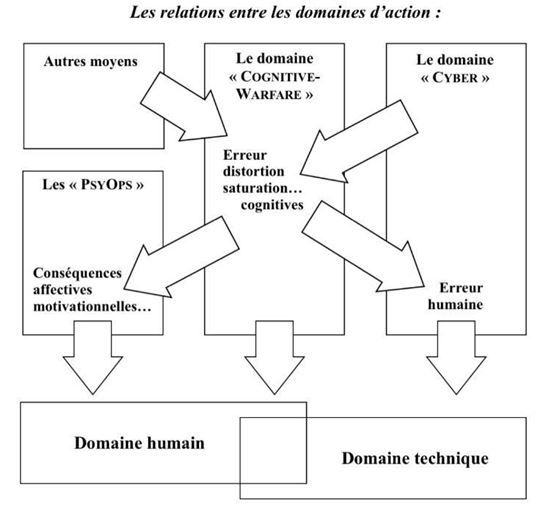
“Cognitive warfare” therefore has effects in the technical domain, but also in very human domains: “CogWar gives rise to the adversaries’ ability to shape human cognition, perception, sensemaking, situational awareness, and decision making at all levels. (…) CogWar also aims at disrupting relationships and targets human vulnerabilities, such as trust and cognitive bias, at both individual and national levels”[5].
Perception, sense-making, decision-making, human relationships, trust… these are terms very familiar to the world of management.
That is why the avenues explored by the military world can usefully inspire the business world – and vice versa.
Finally, it is worth noting that new technological developments lead specialists to consider that this “CogWar” is more than an extension of “psychological warfare” (“PsyOps”), since it combines these “PsyOps” with “InfoOps” and “CyberOps”, adding artificial intelligence and machine learning tools[6].
Areas, here again, into which companies are rushing.
The security “house”
To face these multifaceted threats – and because, contrary to some hasty claims, the Atlantic Alliance was far from “brain dead” – a NATO working group proposed a model (“The House Model”[7]) resting notably on three pillars:
- Neuroscience, with interventions at the individual and collective levels;
- Cognitive and behavioural sciences, with psychological interventions;
- Social sciences (society and culture), with interventions relating to trust and relationships.
These three pillars naturally have applications in companies.
Neuroscience is still in its infancy here, despite the appetite that scientific (or pseudo-scientific) claims can arouse, both among decision-makers keen to “decode” their employees’ behaviour as “scientifically” as possible, and among more or less serious service providers. Because what is at stake here is physiological and biological knowledge of sense-making, decision-making and the workings of the brain.
Technical means make it possible to observe ever more precisely the areas of the brain activated by different stimuli and the production of certain hormones and other molecules. But between observation and understanding, caution is called for. Because concomitance and causality are not the same thing.
Cognitive and behavioural sciences are far more explored and better known, since they concern psychological knowledge of sense-making, here again, of social interactions, human behaviour, emotions, persuasion and communication. Here too, observation has been going on – for longer than in neuroscience – and some propose frameworks of analysis, cautious or more assertive. One might mention, for example, the famous “nudge” popularised by a government agency during the Covid-19 crisis, whose principles inspire other applications in our daily lives.
As for the social sciences, interdisciplinary approaches make it possible to better understand the structural and institutional factors in the social, cultural, economic and political context that shape, constrain and/or amplify individual and collective behaviour and can lead to large-scale change[8]. Here again, the literature and many training courses offer plenty to quench one’s thirst for more or less satisfying explanations.
Finally, in addition to these three pillars, the model proposes cross-cutting layers, the last of which is “situational awareness / sensemaking”, already mentioned in the three pillars.
These terms resonate doubly in the business world, since they come from an approach used both in industrial safety and in collaborative management practices.
Are companies absent from cognitive warfare?
For some months now, France seems to have been hesitating over whether or not to move, at least partially, to a “war economy”… The debate is too complex to address here but, for the time being at least, this “war economy” seems to concern above all the companies of the defence industrial and technological base: the arms industry… Except that, with so-called dual-use technologies and in “hybrid wars”, the boundary between the “military” and “civilian” worlds is hard to draw.
Yet, because they are employers and, in practice, places where their employees spend a large part of their lives, companies must be aware of their role in these cognitive wars, at least defensively:
- in territories where our armed forces might intervene under our defence agreements. And where it would be useful to enjoy at least a benevolent, and why not a cooperative, attitude from local populations, through their employees and customers – one naturally thinks of all our companies operating in those territories;
- and, for the majority, on national territory, by securing their employees’ incomes, by reducing factors of uncertainty and anxiety, and of social fragmentation too. Or even by helping to develop their “resilience”, including in their daily lives.
This last point is crucial, because trust, as we know, cannot be decreed.
And above all because trust is not (only) the business of the state – which, on the other hand, is in charge of military affairs.
“(Cognitive warfare) seeks to sow doubt, to introduce conflicting narratives, to polarise opinion, to radicalise groups, and to motivate them to acts that can disrupt or fragment an otherwise cohesive society”[9].
Of course, calls for social cohesion, even for “national unity”, are often used by political leaders in times of crisis. But like crying wolf, and for many reasons, such calls have probably lost some of their effectiveness.
That is why companies, far more than potential subordinates that could, if necessary, be requisitioned to support the armed and security forces, could also usefully be regarded as partners in the cognitive war that is already raging.
Partners aware of their responsibilities, in their policies and practices. Partners considered within an “allies strategy”, and therefore subject to modes of relationship other than the purely directive one. A mode of relationship too often used between public and private actors, whereas it should be reserved for opponents, and certainly not used with potentially cooperative actors, at the risk of losing them.
Cognitive warfare and social climate
“The battlefield is everywhere”[10]: this is one of the principles not only of cognitive warfare, but also of strategic cultures other than our own in the West.
We spend a great deal of time at work, and the experiences we have there inevitably shape our view and practice of social interactions in the broad sense.
Bureaucratic, inappropriately directive or ethically questionable practices may, for example, lead to disengagement and mistrust. In the company, but perhaps more widely, particularly if legitimately felt resentment is reframed within a more political narrative.
Conversely, management and relationship practices that respect commitments made and recognise the work done, for example, can lead people – also outside their work context – to (re)discover habits based on greater mutual trust. Trust, a key factor in cognitive warfare…
In this area of working relationships, the distance made easier by “remote working” – whether wanted by employees, by companies keen to save on property costs, or by managers not very fond of human relations – is a further factor weakening social relationships:
- by reducing professional activity to its “productive” dimension, whereas it gains so much from also being interactive, whether for creativity or for breaking down cognitive silos;
- and by weakening, psychologically and socially, isolated individuals who may become economic and/or cognitive “targets”, far from their managers – provided, however, that managers are trained to spot “weak signals”.
And as we can see in companies, “remote management” has its limits, despite the many training courses offered after the shock of the switch to remote work during the Covid-19 crisis. Because people try, in vain, to extend existing practices rather than question the substance of the managerial relationship and put those same relational practices into action.
So, when it comes to managing the social climate and, more broadly, managing stakeholders, one might recommend acquiring the approaches and practices of sociodynamics and of the “allies strategy” that derives from it – all the more so as it is inspired by the game of Go rather than chess: an emphasis, therefore, on relationships rather than on the win/lose outcome mentioned in the article cited above[11].
And also because sociodynamics includes organisational practices that echo the recommendations of a “best-seller” of strategic thinking: the “team of teams” recommended by General McChrystal[12], which combine autonomy and coherence, a taste for initiative and a sense of belonging, and which sociodynamics describes as “holomorphic organisations”.
One more reason to take an interest, isn’t it?
Cognitive warfare and disorientation
“In contrast to PSYOPS, CogWar focuses on the exploitation of cognitive vulnerabilities including attention overload, perceptual narrowing (“tunnel vision”), and cognitive biases and errors of judgment that detrimentally influence decision making (Figure 6-1)”[13].
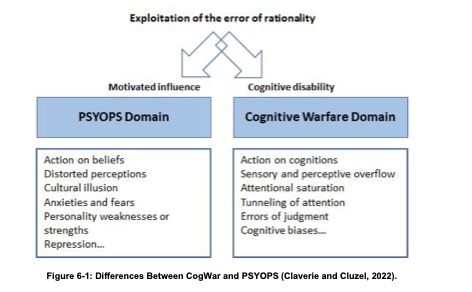
These harmful effects of disorientation are well known to companies, particularly those facing safety challenges: in energy, aviation, mining, shipping, medicine… and which have decided to adopt the new approaches to safety – the “New Views on Safety”[14].
Because disorientation means loss of attention, loss of meaning… the inability to pay the necessary attention to an event or, on the contrary, a lack of vigilance in the face of information that, though falsified, seems credible…
And it is interesting to find in the NATO work mentioned above two key terms from one of these two approaches: that of “High Reliability Organisations” (HROs). Namely “situational awareness”[15] and “sense-making”.
One may regret, however, that these studies make no explicit reference to one of the key authors of these new approaches: Karl E. Weick[16].
Because reading his work makes it possible to identify answers to one of the difficulties mentioned in the study, namely the difficulty organisations have in achieving collective situational awareness: “for example, by knowingly providing contradictory information to team members, or at different hierarchical levels, one can lead to the construction of inconsistent representations or to conflicting perceptions within a team. The long-term impact may be a degradation of interpersonal trust, of confidence in one’s own judgement and of team cohesion. (…) The defence challenge therefore concerns the methods and tools for strengthening collective cohesion, as well as the reliability and security of information systems”[17].
An observation that applies as much to companies’ daily lives as to the challenges of collective mobilisation in the context of cognitive warfare.
Facing disorientation: “mindfulness”?
Karl Weick is indeed one of the key thinkers on organisational culture – a “culture” kept alive through shared practices, which enables organisations to succeed in complex socio-technical contexts – since HROs grew out of the observation of systems such as aircraft carriers, oil platforms, air traffic control, hospitals or firefighters facing large-scale forest fires…
Weick (and HROs) have the “drawback” of being psychologists rather than engineers. Which, for “serious” subjects, can be a handicap…
And even more so because Weick goes beyond the notion of “situational awareness” (SA) by proposing that of “mindfulness” – a term that is sometimes poorly received.
Where SA recommends attention limited to the scope of one’s own domain – leading to siloed attention, and therefore to difficulties at the interfaces – “mindfulness” recommends broader attention, including to other people’s domains – which implies the necessary cooperation.
And where SA pays attention to the details of the task in hand – attention that can be disturbed by distractions – “mindfulness” pays attention to the emergence of the unexpected – including when it emerges from someone else’s domain… Like the regular walk of all personnel across the deck of an aircraft carrier to make sure no stray object is lying there, without looking for a “culprit” who might have left it…
“Mindfulness” is therefore collective by nature: “We prefer the concept of expertise to that of expert because we want to preserve the crucial argument that expertise is relational”[18].
But the term immediately makes many “serious” decision-makers, military or civilian, step back. Because “mindfulness” immediately brings to mind approaches that can be described as “personal development”, hardly welcome in discussions of organisational resilience, still less of collective defence.
Yet “mindfulness” is far more about organisational resilience than about personal well-being alone: “The key questions, for individuals as for systems, are: ‘Can I concentrate to avoid distractions, so as to be attentive and calm?’ and ‘Do I return quickly to my activity when my mind wanders?’”[19].
This is probably why, while acknowledging the links some make with philosophical traditions and practices such as Buddhism and meditation, specialists in “human performance optimisation techniques” – well known to personnel working under high levels of constraint, such as fighter pilots or special forces soldiers – draw on this concept, despite possible reservations of principle[20].
Facing disorientation: sense-making
This omission is all the more regrettable as Karl Weick is also behind important work on “sense-making”.
A “sense-making” that is crucial to cognitive warfare: “To achieve this level of understanding in evolving non-linear events, (…) is reliant on sensemaking ability. (…) Sensemaking informs and is a prerequisite to decision making. In contrast to SA, (…) Sensemaking requires continuous effort and motivation to understand connections among people, places, and events (the system of systems) to anticipate their trajectories and act effectively”[21].
And for Weick, “sense-making” is, here again, eminently collective and organisational: “Some organisations can produce ignorance, tunnel vision and normalisation, while others can produce new ideas, original syntheses and unexpected diagnoses”[22].
Weick’s work, and the associated practices, can therefore be useful for the cognitive warfare that concerns security organisations such as NATO, but also, more locally, those dealing with the particularly sensitive sectors mentioned (nuclear, firefighting, healthcare…).
They can also be useful – as a few keywords familiar to organisational and human factors consulting suggest – to companies in less critical sectors, but for which collective effectiveness is essential.
Because in companies, “loss of meaning” does not only come from outside (except in cases of attempted fraud or malicious action). It can come, more prosaically, from within. And most often for unintentional reasons.
Organisational dysfunctions, clashes of egos, contradictory injunctions… the organisational and human sources of “loss of meaning” can be many. But the effects are similar to those of a cognitive war – waged this time unintentionally, because it emerges from management practices.
That is why these questions of “disorientation” – and the answers that can be given to them – are also common ground between the military and civilian worlds. And therefore ground for synergies.
Cognitive warfare and automation
Finally, cognitive warfare has an important technical dimension.
“Cognition is no longer just a matter of the brain; it is, at least over the past decade, linked to digital technology and shared knowledge. This double relationship is therefore bilateral and dual. It is bilateral because digital technology is a product of cognition, and cognition now needs digital assistance. It is dual because these relationships concern both the individual and communities”[23].
The “New Views” already mentioned rest broadly on two main approaches: one more human and psychological, the other more technological and engineering-based[24].
And the NATO work shows the same convergence with the world of these “New Views on Safety”, this time with the engineering side, human-machine coupling and “Resilience Engineering”[25].
A convergence that is in fact long-standing since, for example, one of the seminal authors of these approaches, Jens Rasmussen, was behind a NATO seminar in August 1980[26].
And what already concerned researchers and practitioners with the increasing automation of systems, and the necessary synergy with human cognitive systems, is of course brought up to date by a cognitive war that relies more than ever on interactions between people and technical systems…
Note the term used: “Human-Machine Teaming”. Because when it comes to resilience, the point is not replacing humans with machines, but coupling humans and machines.
A point of vigilance that may well escape organisations keen to accelerate their “digital transformation” by giving attention, time and budget to the technological aspects alone (I am struck by the number of vacancies, in companies and consulting firms, for “Transformation” project managers whose expected skills are above all technical), with the idea that “the people will follow” (at best, they will be “trained”)…
Because our companies remain, above all, human organisations – even if some companies seem to regard certain humans as the new slaves of digital systems[27].
“Great replacement” or mutual trust?
All the more so as artificial intelligence is in the news, with both technological acceleration and a fashion effect, like the one we saw ten years ago with “digital transformation”. Or with the introduction of ERP systems twenty years ago, those “magic” systems integrating all of a company’s data. Introduced through many development iterations, with “training” to try to get people to adopt the tool…
A fashion effect that pushes organisations to adopt new tools to seek greater efficiency and free teams from low-value tasks, certainly. But also, too often, to show signs of “modernity” or simply to do “the same as everyone else”, without necessarily taking the time to think about the consequences of this “great replacement”.
And here again, NATO researchers draw our attention.
“Military leaders must be made aware of the ethical consequences associated with extensive AI/ML networks that support social media platforms, AI facial recognition surveillance systems, AI Situational Awareness systems, autonomous weaponized systems, autonomous unmanned systems, AI Robotics, etc., that present significant challenges in the defence against CogWar. These technologies impact civilian, military and society itself (…). Education, training, and experience will prove to be pivotal elements in NATO’s CogWar defence strategy for the future”[28].
The first question is therefore an ethical, philosophical one. Because the introduction of these tools has consequences for how companies work, for the place of the women and men who work in them, and for the nature of human relationships in general.
And the pursuit of short-term profit, legitimate for companies’ survival – or worse still, the mere desire to be “on trend” – must not make us forget the long-term consequences. For the company itself, but also for society and the ecosystems in which it operates and on which it depends.
Another question is the inevitable one of how these new tools – and the practices associated with them – are introduced.
Because one can see this as a “great replacement”. But also consider that these developments require us to ask, even more acutely, the question of collaboration between people and “intelligent machines”. Collaboration: a principle of action based on trust.
“Avenues for progress lie, on the one hand, in the ability of these machines to explain themselves better, to establish well-founded trust, to communicate more easily, and even to understand the hidden intentions and emotions of human actors, and on the other hand in a new culture of acceptance of machines by humans”[29].
A question that may send a shiver down the spine, but which in any case must be put to decision-makers, civilian or military, so that they truly take ownership of it, rather than leaving it solely to technology specialists, who already have so much to do…
Companies, a field of action and training
War has to be prepared for. In cognitive warfare as in other, more mechanical or physical forms, training is necessary.
Once again: we spend a great deal of time at work. That is why we recommend considering this space both as a field of action, with benefits directly expected for economic activity, and as a training ground for citizens facing a cognitive war that may determine the future of our democratic societies – and of their professional effectiveness, if that absolutely has to be pointed out.
Because everyone has a “cognitive personality”: “Cognitive personality is an individual’s spontaneous way of knowing the world”[30].
And like all our personal traits, it evolves. For the better, and no doubt also for the worse. A “worse” that might be seen in the “editorialised world” described by Gérald Bronner in his excellent Apocalypse cognitive[31]… whose very title is an example (what talent!) of the features that most easily capture our attention: catastrophism, cognitive incompleteness, indignation…
But a “worse” that can be reduced, and a “better” that can be developed – and reading Gérald Bronner’s book contributes greatly to this, as do several of his other works.
Because should we expect anything from the media, or from social networks?
As the author shows, the harmful mechanisms that are so often described and decried are not due to a conspiracy, to a deliberate intention to “manufacture idiots” (the title of another reference work in French). They are rather a response to our own cognitive appetites…
So every entrepreneur, public or private, whose business model does not rest exclusively on the attention economy (which does not prevent them, in theory at least, from being as virtuous as possible) can, in their professional and daily practices, help to develop the better and reduce the worse. Their own, and that of those over whom they have influence, responsibility or an educational role.
Taking back control of our decisions, and of action
Cognitive warfare diverts us from what matters most: the decision-making that precedes action.
In its military dimension, this is one of the objectives of the hostile force, as the diagram below shows[32]:
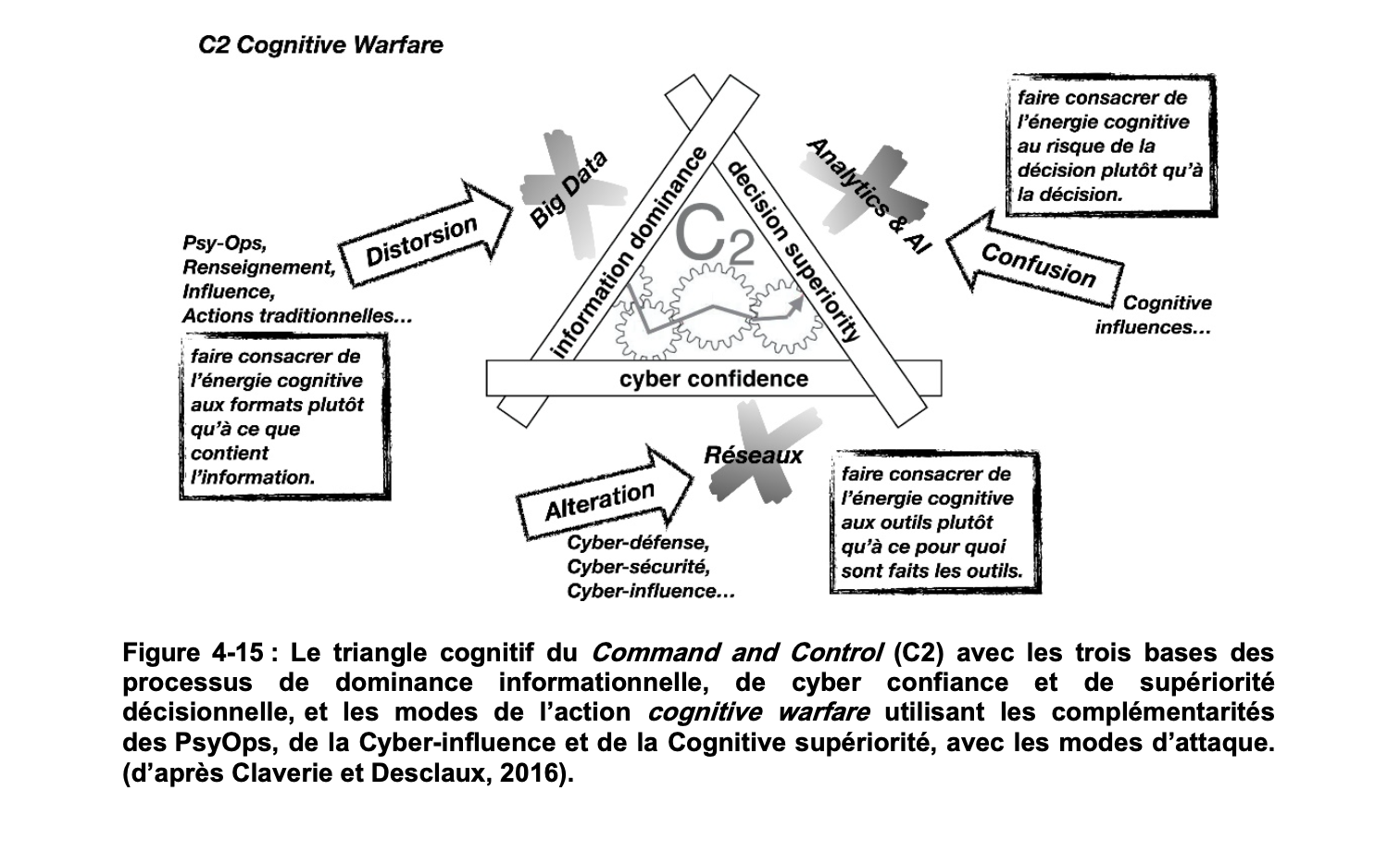
But in companies, this confusion is mostly caused, with a few exceptions, by other mechanisms. There is no “conspiracy”. Only the side effects of mechanisms of fashion, attention, loss of meaning, organisational dynamics…
Effects that are perfectly described in the diagram above.
- The attention paid to new tools, which capture attention and budgets: this is “making people devote cognitive energy to the tools rather than to what the tools are for”.
- The attention devoted to the aim of “knowing everything” thanks to data (even if the observed impossibility of processing the data in “data lakes” now seems to have led many companies back to more common sense): this is “making people devote cognitive energy to formats rather than to the content of the information”.
- As for bureaucratic ways of working that put “knowledge” before action – notably because of an ever-growing aversion to risk, but also because of the natural evolution of these “knowledge” organisations – they appear in “making people devote cognitive energy to the risk of the decision rather than to the decision itself”.
That is why organisational transformations must not be driven by fashions or by models transposed without due care.
And the attention economy also has its counterparts in the business world, where shared calendars – the tool – and the rolling-out of centralising, bureaucratic paradigms – the substance – end up saturating decision-makers’ attention through their diaries.
The prerequisite for action is decision. A decision taken with time for perspective and maturation – essential to any creativity, including strategic creativity.
That is why, in this area, we recommend prioritising and allocating the resource of “time”. A resource that practices such as “chronostructure”, for example, help to manage better.
Towards a collective intuition?
To cope with the cognitive overload feared by military and civilian decision-makers alike, Karl Weick highlights one of the five principles of high-reliability organisations: “deference to expertise”. What the armed forces describe as “function takes precedence over rank”, that is, relying on the hierarchy of skills rather than that of the organisation chart… And which, for Weick, let us remember, is a collective expertise.
This is more commonly called delegation in management practice. But not “hierarchical” delegation, which risks being merely the expression of a desire for control. Delegation to skills.
Which means, for example, not being afraid to surround oneself with team members whose skills are more developed than one’s own. More developed locally, but often narrower. Until they grow, which is also a managerial challenge.
Faced with this “cognitive overload”, Weick also proposes “sense-making”: what makes it possible to give meaning, or not, to an event. And for him, this capacity to make sense is linked to experience, expertise, and what can be called “intuition” (insofar as it rests on the first two)[33].
This “intuition” is close to what Daniel Kahneman – also cited in the NATO work – calls “System 1”: “Methods need to be found that augment and help people learn to be vigilant intuitively. (…) This will also help them regulate their own behaviors, so they become learned System 1 intuitive behaviors. (…) The process of making intuition a positive resource rather than a bias involves individuals understanding the mechanisms of CogWar, so they have a greater chance of intervening”[34].
Making “System 1” a strength, when it is often described as the “weak link” of our vigilance, since it is sensitive to biases, prejudices and habits?… Whereas “System 2” is valued in this respect, with the usual appeal to reason and reflection. That may come as a surprise.
But it is a pragmatic point of view – where many rely on an “ideal” world.
Since “System 1” is that of immediacy, in which we are immersed, and also that of survival reactions, we might as well “harden” it through training, rather than merely calling for the primacy of “System 2”.
But here again, Weick’s recommendations make it possible to ensure that “System 2” remains on active standby and works as a regulator. By relying on collective expertise and shared sense-making, which make it possible to question regularly what we are doing.
Which requires keeping the necessary time. For oneself. And with others.
Is hell other people? Or working better together?
As we can see, cognitive warfare is therefore everyone’s business. And therefore companies’ business too, and not only as auxiliaries in a “war economy”.
Cognitive warfare requires technical means, certainly, but also collective practices that improve overall resilience – that of the network of citizens we all are, in all our activities.
At the heart of this cognitive effectiveness lies the collective.
This statement may seem surprising because, in matters of attention as in others, one may (rightly or wrongly) consider that “hell is other people”, as Sartre put it.
Of course, part of our activity must legitimately involve individual work – particularly because, in the end, when facing the decision, “the leader is alone”. This is essential, and this work is often done “in the background”, during physical exercise that irrigates the brain, or during sleep, which processes and organises the information available.
But while the final decision is a solitary act, the process leading to it should naturally be collective. Not least because the effective implementation of that decision can only be collective.
That is why, in this area as in others, it is essential to “work better together”.
And we can help you do so!
Note: quotations from the NATO report “Mitigating and Responding to Cognitive Warfare” and from NATO Review are given in their original English wording. Those from Karl Weick’s books (notes 18, 19 and 22) and the quotation in note 30 were translated into French for the original version of this article and have been translated back into English here; please refer to the original sources for the exact wording.
[1] Which, let us remember, remains the other official language of the Atlantic Alliance.
[2] « Le cognitive warfare et l’avènement du concept de ‘guerre cognitique’ », Bernard Claverie, François Du Cluzel, in « Cognitive Warfare : la guerre cognitique », B. Claverie, B. Prébot, F. Du Cluzel, NATO-CSO-STO, October 2021, available at: https://innovationhub-act.org/wp-content/uploads/2023/12/NATO-CSO-CW-2021-10-26.pdf
[3] « La guerre cognitive : agir sur le cerveau de l’adversaire », David Pappalardo, Le Rubicon, 9 December 2021. Available at: https://lerubicon.org/la-guerre-cognitive/
[4] Many articles have been devoted to the subject. Podcasts too, such as this episode of the French podcast “Le Collimateur” hosted by Alexandre Jubelin: « Trouver une réponse face aux manipulations de l’information. Vie et destin de Viginum », 16 April 2024, with Marc-Antoine Brillant, available on all platforms.
[5] “Executive summary”, in Mitigating and Responding to Cognitive Warfare.
[6] “Towards a framework of science and technological competencies for future NATO operations”, Janet M. Blatny, Yvonne R. Masakowski, in Mitigating and Responding to Cognitive Warfare – STO Technical Report, NATO, March 2023, available at: www.sto.nato.int
[7] “Towards a science and technological framework – The House Model”, Benjamin J. Knox, in Mitigating and Responding to Cognitive Warfare.
[8] These descriptions are taken from the article cited above.
[9] “Countering cognitive warfare: awareness and resilience”, Johns Hopkins University & Imperial College, NATO Review, 20 May 2021. Available at https://www.nato.int/docu/review/articles/2021/05/20/countering-cognitive-warfare-awareness-and-resilience/index.html
[10] « La guerre cognitive : pourquoi l’Occident pourrait perdre face à la Chine », Kimberly Orinx, Tanguy Struye de Swielande, in « Cognitive Warfare : la guerre cognitique », B. Claverie, B. Prébot, F. Du Cluzel, NATO-CSO-STO, October 2021
[11] To find out more about sociodynamics, see the work and activities of the Institut de la Sociodynamique (https://www.institutdelasociodynamique.com). And/or contact me for management training sessions or support for your humanly sensitive projects.
[12] “Team of teams. New rules of engagement for a complex world”, General Stanley McChrystal, Portfolio Penguin, 2015
[13] “Developing cognitive neuroscience technologies for defence against cognitive warfare”, Claude C. Grigsby, Richard A. McKinley, Nathaniel R. Bridges, Jennifer Carpena-Nunez, in Mitigating and Responding to Cognitive Warfare.
[14] See in particular: “The ‘new view’ of human error. Origins, ambiguities, successes and critiques”, Jean-Christophe Le Coze, 2022, in Safety Science, 54, 105853.
[15] « Le partage de conscience de situation est un lien de fragilité cognitive », Baptiste Prébot, in « Cognitive Warfare : la guerre cognitique », op. cit.
[16] “Managing the unexpected. Resilient performance in an age of uncertainty”, 2nd edition, Karl E. Weick, Kathleen M. Sutcliffe, Jossey-Bass, 2007
[17] Baptiste Prébot, op. cit.
[18] “Managing the unexpected. Resilient performance in an age of uncertainty”, 2nd edition, Karl E. Weick, Kathleen M. Sutcliffe, Jossey-Bass, 2007
[19] Ibid.
[20] See, for example, the new podcast “Optimizing Human Performance”, co-produced by The Wavell Room – a leading British website on military affairs – which refers explicitly to these concepts.
[21] “Situational awareness, sensemaking and future NATO multinational operations”, Benjamin J. Knox, Yvonne R. Masakowski, in Mitigating and Responding to Cognitive Warfare, 2023, op. cit.
[22] “Managing the unexpected: complexity as distributed sensemaking”, Karl E. Weick, in “Making sense of the organization. The impermanent organization. Volume 2”, John Wiley, 2009. Weick speaks of “networks”, but we have rendered it as “organisations” as a shorthand for an argument made earlier in the book.
[23] « Qu’est-ce que la cognition et comment en faire l’un des moyens de la guerre », Bernard Claverie, in « Cognitive Warfare : la guerre cognitique », op. cit.
[24] See for example “Vive la diversité! High Reliability Organisation (HRO) AND Resilience Engineering (RE)”, Jean-Christophe Le Coze, in Safety Science, Volume 117, August 2019 – doi:10.1016/j.ssci.2016.04.006
[25] Notably in “Human-Machine teaming towards a holistic understanding of cognitive warfare”, Frank Flemisch, in Mitigating and Responding to Cognitive Warfare, 2023, op. cit.
[26] “Human detection and diagnosis of system failures”, edited by Jens Rasmussen and William B. Rouse, NATO Conference Series – Human Factors, Plenum Press, 1981
[27] For example, the article « Aux Philippines, avec les petites mains de l’IA » (In the Philippines, with AI’s hidden workers), Les Echos Week-End, 24 May 2024
[28] “Defense against 21st century cognitive warfare: considerations and implications of emerging advanced technologies”, Yvonne R. Masakowski, Eskil Grendahl Sivertsen, in Mitigating and Responding to Cognitive Warfare, 2023, op. cit.
[29] « Confiance entre les humains et les machines intelligentes, et biais cognitifs induits », General Gilles Desclaux, in « Cognitive Warfare : la guerre cognitique », op. cit.
[30] “Defense against 21st century cognitive warfare: considerations and implications of emerging advanced technologies”, op. cit.
[31] « Apocalypse cognitive », Gérald Bronner, PUF, 2021
[32] Bernard Claverie, op. cit.
[33] “Information overload revisited”, Kathleen M. Sutcliffe, Karl E. Weick, and “Organizing and the process of sensemaking”, Karl E. Weick, Kathleen M. Sutcliffe, David Obstfeld, in “Making sense of the organization. The impermanent organization”, op. cit.
[34] “Cognitive and behavioral science (psychological interventions)”, Benjamin J. Knox, in Mitigating and Responding to Cognitive Warfare, op. cit.
Leave a Reply