
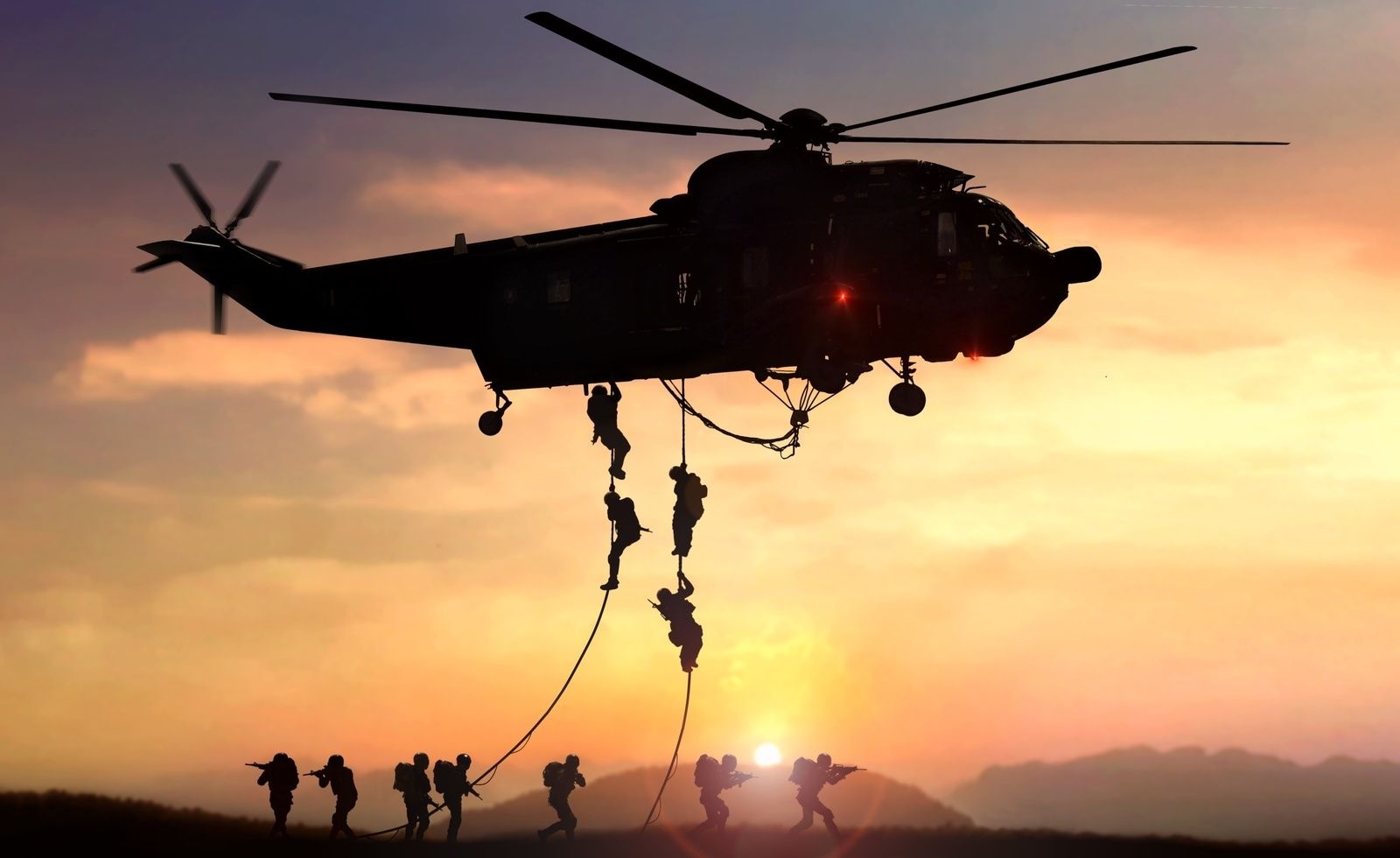
The military world – or our perception of it – sometimes inspires business leaders facing the ups and downs of markets and corporate life. Irregular warfare, as topical as it is ancient, should also be among those sources of inspiration.
Since the end of compulsory military service in France, for those who do not want to make the profession of arms their main commitment, there have been military preparation courses, voluntary service and the operational reserve – so many opportunities to enrich one’s life experience and acquire original skills, for oneself and for others.
For those who want to discover and experience the practices of soldiers, over shorter but humanly intense periods, individually or with their team, there are notably the excellent initiatives of Saint-Cyr Formation Continue (the continuing education arm of the French military academy)[1], or of former members of the armed forces who have moved into management development.
And then, for everyone, there is the steady output of military – or more broadly strategic – literature. You do not experience intense moments in your flesh and will. But you can learn a great deal.
Far from being reserved for military specialists, Elie Tenenbaum’s very comprehensive book on “irregular wars”[2] can be a source of inspiration for many business, and even political, leaders – and, in this holiday season conducive to stepping back, a summer read.
Getting out of the quagmire
Twentieth-century irregular warfare was born of the stalemate of the First World War. The conflict was bogged down in trench warfare. To gain ground (business leaders would say “market share”), people had to think differently. Stop doing “more of the same”. Get behind the lines with autonomous and atypical teams, “change the board” by striking at the morale of the troops and of the home front…
During the Second World War and throughout the 20th century, this led notably to the creation of commandos, with their spirit and skills, of special forces and their concepts of employment, of psychological operations, of resistance networks and their support and leadership, of insurgency and counter-insurgency…
So many sources of inspiration for companies, which face not an enemy to be defeated, but competitors and demanding contexts to which they must adapt in order to master them.
The Jedburgh spirit for conquering territories
Everyone knows, or at least imagines, the “commando” form and spirit. Elite teams – highly trained, highly equipped, close-knit, versatile, experienced in special operations, ready for the impossible… Exceptional women and men who command admiration.
In the business world, the term is sometimes used: there, a “commando” operation means brevity, dedicated resources, determined men and women. Is that all it is?
To learn more about the soul of commandos, you can listen – again, summer is a good time – to the interview with Admiral Marin Gillier (who became known to the general public when he parachuted into the sea, alongside his counterpart from the GIGN, the French gendarmerie’s elite intervention unit, during the rescue of the yacht Le Ponant) on IRSEM’s podcast « Le Collimateur » of 9 July[3]. Among so many other things and powerful moments, it shows how different commando “styles” are from one service to another: faced with the same difficulty, some are determined to guide the force to the end, others to hold the ground, and others still to disappear and come back later… And the differences are even greater from one country to another.
For companies, if one wants to go beyond the mere slogan of the “commando” operation, there cannot be a single “model”, but rather principles of training, preparation and action that apply to a given corporate culture, to a particular context and objectives, and that rely on specific resources. Tailor-made.
Equally inspiring, and devised in the same period but for even more atypical operations, Elie Tenenbaum recalls the creation of the Jedburgh teams, which after the Second World War would give rise to many “irregular warfare” operations.
For companies, the Jedburgh idea seems even more relevant than “commandos”. Because rather than an operation of brute force, it involves conquering a territory with very limited resources (3 people), by relying on the people who live there. For projects providing services to regions, or for conquering new markets, this approach is more relevant than a show of force. Because in a “trade war”, you have to last…
The division of roles within the Jedburgh team of three is important: in short, a representative of the main forces, a representative of (or at least a specialist in) the populations concerned (sociologists would speak of a “marginal secant”), and a technician. And these three chose each other and trained together. Cohesion is key.
For analogies with corporate dynamics, the lesson is powerful: it is about ensuring genuine collaboration between personalities (and entities) that are a priori very different. The representative of the main company, guarantor of alignment with the strategy adopted (the armed forces speak of “the commander’s intent”) and of the capacity to deploy the necessary resources; the actor rooted in the territory (physical or economic), who knows its specific features and will enable the actions undertaken to be adapted; and the expert, who can provide technological resources and ensure they are implemented. No precedence among the three, but a complementarity that guarantees innovation, adaptation and success.
Whether for a team of three or for larger teams, these principles of balance and division of roles are very inspiring.
Integrating the atypical?
Finally, one observation emerges from reading this book: throughout the decades and events discussed, the conduct of irregular warfare gives rise to real rifts within the armed forces and the political authorities that direct them. Because the “irregular” conduct of conflict calls for divisive practices – and probably a divisive philosophy. The opposition between “partisans” and “centurions” reflects the dual identity of military personnel: both soldiers and civil servants. They are those who have chosen both the profession of arms and the service of the State. And in this respect, the career paths of irregular warfare specialists (sought after, trained, then sidelined, and later recruited on the margins…) illustrate the difficulty of classic institutions – some would say “bureaucratic” ones – in integrating, or even accepting, “non-conforming” personalities and skills.
The parallel with large companies then comes to mind. Faced with “disruption”, they sometimes seek to acquire atypical skills, by recruiting talent or acquiring teams, often at a high price. They create a department or a subsidiary, and proclaim their ability to face new challenges. But in practice, they then struggle to retain these particular personalities, and to use these skills to adapt, or even transform themselves.
Is the opposition between “partisans” and “centurions” inevitable because it is essential? Or can we imagine “cross-fertilisation”? The debate is open!
[1] www.scyfco.fr
[2] « Partisans et centurions : une histoire de la guerre irrégulière au XXe siècle » (Partisans and centurions: a history of irregular warfare in the 20th century), Éditions Perrin, 2019
[3] « Le Collimateur », IRSEM podcast, episode of 9 July 2019 (in French), available on podcast platforms
Leave a Reply