
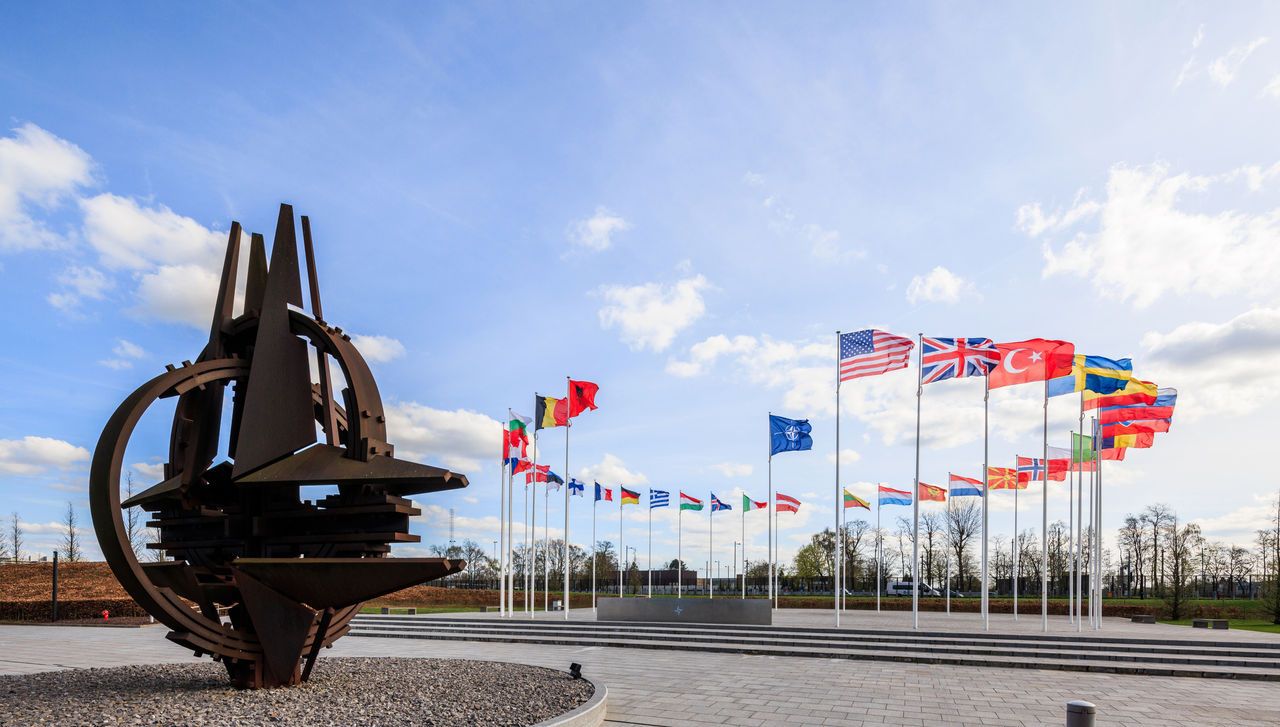
In his speech of 20 January 2026, Canadian Prime Minister Mark Carney spoke of a “rupture”, in order to adapt to the world “as it is”. Is it really a rupture, or a new evolution?
The Atlantic Alliance has been through many crises, and the “burden shifting” at the heart of the current transformation is not a new question: it was raised from the very beginning. But it is true that this “shift”, as it now presents itself, would grant Europeans more or less autonomy. Which, for those concerned, can look like contradictory injunctions: “do it all yourselves, but not without us”.
Back in 1975, Raymond Aron was already calling on “my friend the American Secretary of State (Henry Kissinger, author’s note) (who) would only need to do one piece of reading, namely the books he wrote when he was a professor at Harvard”, to ask him, at the time, to take a more benevolent attitude towards the Common Market.
Professor Pierre Melandri, for his part, described the late 1990s as the shift, from the American point of view, from the “new Atlanticism” wished for by US Secretary of State James Baker to a “lite” alliance, that of George W. Bush: “as a result, too, more than ever, the Americans seemed to want at all costs to prevent the emergence of a united Europe that might threaten a unipolarity raised to the status of a panacea”.
The Alliance is undergoing major changes, certainly. But if there is a “rupture”, it is perhaps above all in the style of some, in a world where blows were exchanged, but in a polished way.
No one, apart from Putin and his henchmen, really wants the end of the North Atlantic Treaty Organization (NATO). To adapt to the world “as it is”, and not “as we would like it to be”, it must therefore succeed in its transformation.
So, since NATO must transform itself, do we prefer an imposed transformation (moving, for example, towards a “Warsaw Pact” model) or a chosen transformation (rediscovering the spirit and the workings of Euro-Atlantic solidarity)?
The proposal developed here is that it is possible to transform NATO while remaining faithful to its purpose and to the spirit of its founders, by adapting it to meet the diverse expectations of its members. And to do so by drawing on certain fundamentals of the Atlantic Pact, as it was called in the 1950s, by remembering its “raison d’être” and by adapting its workings to what it should never have stopped being: a collective dynamic.
Two types of argument will be presented here in support of this proposal.
Some come from my professional experience of leading transformations in organisations.
And unlike Olivier Schmitt, I believe that certain practices of “civilian” organisations can be applied to the transformation of the Alliance.
First, because NATO is a political-military alliance, not just a military one. And also because the military world, despite the very particular nature of its combat missions, has many similarities with civilian organisations.
By way of illustration, in an article in the January issue of the French magazine DSI, Laure Bardiès recalls “the most pervasive aspects of military bureaucracy” described in Marc Bloch’s book on the reasons for the 1940 defeat, Strange Defeat. Because “bureaucracy” and its effects are common to all large organisations, whether military or civilian.
On a lighter note, Thierry de Montbrial remarked, when presenting Hervé Pierre’s book on André Beaufre at IFRI, that “there is plenty of scheming in the armed forces too”… as in many human organisations. And readers involved in the life of these organisations will no doubt have other examples, as I have experienced myself.
The other arguments come from the past and present of the Euro-Atlantic associations brought together within the Atlantic Treaty Association (ATA), whose French branch is the Association Française pour la Communauté Euro-Atlantique (AFCEA). An association whose historical foundations draw in particular on the action of Georges Bidault on the political side – who, with Britain’s Ernest Bevin, was one of the main architects of the Alliance – on Raymond Aron on the philosophical side, and on General André Beaufre on the military side.
Those whom Olivier Zajec mentioned in the French podcast “La Loupe” in December 2025, for whom “the Atlantic Alliance cannot be reduced to NATO; it is a civilisational alliance, a community of destiny. We share values, a culture and a history with the United States”.
Moving beyond discord by drawing on Article 2
Article 2 of the Washington Treaty promotes the economic dimension of the Alliance and, more broadly, dialogue between the signatory members. It is worth remembering that it is known as “the Canadian article”, because it was introduced at the request of Lester Pearson, then Secretary of State for External Affairs, who believed that political and economic cooperation would remove the causes of war – a conviction shared on the other side of the Atlantic by the champions of European integration.
Article 4, for its part, also refers to the necessary consultation between members, but in the event of a direct threat to their territorial integrity, political independence or security.
Set up in May 1956 to give substance to these two articles, the “Committee of Three” produced in December the “Report of the Three Wise Men”, which recognised the need to broaden cooperation and, very concretely, to make use of “prior collective discussion” between members of the Alliance, beyond purely military matters. And this just a few days after the end of the Suez crisis.
Yet what was emphasised in the “Report of the Three”, and the only dimension actually implemented, was the institutionalisation of scientific and technical cooperation (and even then, it is a field little known outside the specialists concerned).
Perhaps one evolution of the Alliance would therefore be to finally implement Article 2, to accompany the “burden shifting”. This would both strengthen and build on what makes the Alliance strong – everything that goes beyond mere mercantile calculations – in the spirit of what Raymond Aron said in 1975, at the general assembly of the Atlantic Treaty Association (ATA): “the problem of the Atlantic Alliance (and I would even say the problem of today) is to transform, to transfigure de facto interdependence into moral and political solidarity”.
Actors to move beyond current tensions: Euro-Atlantic associations
When an organisation runs into a difficulty in a project or in the way it works, the usual reflex is to focus on that opposition and on the people who seem to embody it.
In consultant’s jargon, this is called “the magpie syndrome”: going for whatever glitters. Whereas, to overcome deadlocks, it is more effective to pay more attention to what unites, to spend more time and energy with those who want to move forward together – to benefit from collective intelligence and from the resources each person brings, to draw in those who hesitate and, in the end, to lead the most reluctant to follow the common movement, willingly or through momentum.
Within the Alliance, this dynamic can be driven with stakeholders subject to fewer constraints than the institutions, such as the Euro-Atlantic associations: organisations that have been studied far too little.
From the early 1950s, voluntary associations were created in each member country to promote the aims and achievements of the Atlantic Alliance. Often at the initiative of civilian and military figures involved in the creation of NATO.
In 1954, the first of them came together within the ATA, later joined by associations in each member country and also in partner countries.
And until the 2000s, the “NATO Handbook” recognised the ATA and each of the national associations as part of its “voluntary organisations”, and later its “parliamentary and non-governmental organisations”, alongside the Eurogroup (1968–1994), the CIOR (Interallied Confederation of Reserve Officers) and even the NATO Parliamentary Assembly.
Throughout these years – and this is my own assertion, not academic proof – and thanks to the relationships they maintained with one another, they contributed to dialogue between committed decision-makers. Former and future political leaders, diplomatic and military experts, economic actors: all of them, through informal but very real relationships, helped to maintain a link and therefore the cohesion of the Alliance, including during periods of tension between member states.
These associations are very diverse in nature.
The ATA is, in the words of Amélie Zima, “a network of national lobbies”, focused in particular on public opinion: “it acts both at the transnational level, with NATO, and at the national level towards member, candidate or partner states”.
Some announce their link with the Atlantic Treaty in their name, while others display an “Atlantic” dimension that goes beyond the treaty itself. Others still refer in their statutes to an “Atlantic Community”, or even a “Euro-Atlantic” one, giving their commitment a very particular depth.
Dean Acheson, the US Secretary of State who would create the Atlantic Council of the United States (ACUS) as the national branch of the ATA, declared at the signing of the treaty that the North Atlantic Treaty was the product of three hundred and fifty years of history: “There developed on our Atlantic coast a community, which has spread across the continent, connected with Western Europe by common institutions and moral and ethical beliefs. Similarities of this kind are not superficial, but fundamental”.
On this side of the Atlantic, the French journal Revue Défense Nationale (RDN) republished in 2012 one of its 1953 articles, signed Claude-Edmond Doors (a pseudonym), which also expressed this purpose: “The Atlantic community will only be fully effective if, on the one hand, Europeans have understood the need to rely on the United States until they are strong enough to support themselves, and if the United States understands, for its part, that it needs Europe not only militarily and territorially but even more spiritually, to find there reasons to think and act beyond the horizons of pure technology and economics. There is here an urgent problem of psychological action between allies and friends.”
These associations are little known, as are the people who run them. And few works mention them.
Jenny Raflik is one of the few to do so, in her remarkable book on NATO and the French Fourth Republic: “A few intellectuals also keep this Atlantic Community alive within various associations, the most important being the AFCA, created in 1954… Lectures are given in this associative setting by high-ranking officers or well-known intellectuals, in order to spread Atlanticist ideas”.
Amélie Zima, who focuses on the more recent period, describes them as follows: “the same profile is often found: a multi-positioned individual, a graduate of higher education, with a network that can be made available to the association. The members’ profile is therefore that of an insider, which reinforces the elitist character of these associations. The aim is not to have as many members as possible, but individuals who, through their qualities, are likely to find access points enabling them to influence decision-making processes or take part in them”.
A study of the membership of these associations, both in France and in other member countries, and practical experience of their activities, nevertheless leave a different impression. They do bring together high-level influencers who no doubt open doors and facilitate synergies. But they also include experts who contribute their knowledge to produce content and speak at conferences; and volunteer members who contribute time, energy and other skills to carry out other kinds of action.
This could be seen, for example, on the panels of the exhibition on “France and NATO” that AFCEA designed for, and with the support of, the Souvenir Français in Paris in January–February 2026, which credited contributors with more varied profiles.
And while Amélie Zima also suggests that “the limit of these organisations lies in their lack of real influence on the decision-making process”, she nevertheless recalls, in another book on the accession of Hungary, Poland and the Czech Republic to the Atlantic Alliance, that these associations were used as levers of influence on public opinion and political life.
They probably have no formal influence on political decisions. But an in-depth study of the past and present activities of these associations would no doubt reveal some educational actions, or even influence, on the environment of these decisions and on the decision-makers themselves – even if this is often very difficult to demonstrate factually.
How associations can contribute to the Alliance’s transformation: the role of the marginal secant
These Euro-Atlantic associations can serve as a lever of transformation for the organisation and its ecosystem by playing their own role, which goes beyond that of mere subcontractors or complements to NATO’s services.
To do so, their main asset is their status as a “marginal secant” (marginal sécant): a powerful asset for bringing about successful transformations.
According to the sociologists Crozier and Friedberg, the position of marginal secant is that of “the actor who is a stakeholder in several interrelated systems of action and who can therefore play the indispensable role of intermediary and interpreter between different, even contradictory, logics of action”.
Yet an “actor” is not only an intermediary and an interpreter, but also someone who acts and can therefore transform their environment.
Members of associations are often marginal secants as individuals.
Like those diplomats, military officers and business leaders, serving or retired, who remain part of their original social body even after leaving it, while also taking part in the associative dynamic.
And although the notion of marginal secant applies first to individuals, the quality can be extended to the organisations that associations are.
Because, thanks to the diversity of their members, bound by a common objective, they are able to foster synergies between their areas of expertise and the worlds they belong to, within a national association and within the international network that brings them together.
And when it comes to adaptability and resilience in the face of crises, this diversity is a major asset.
On inter-organisational relations between institutions and associations
In the English-speaking world, the action of associations is described as the “community and voluntary sector”: what is also called the “third sector”, to distinguish it from the public sector and the for-profit private sector – close to what in France is sometimes called “civil society”, except that in France an association is also a legal form of organisation.
Mandell and Keast give three criteria to characterise VCOs (voluntary and community organisations):
- People acting voluntarily to achieve shared objectives, according to Tocqueville’s “principle of association”;
- Organisations that do not seek profit (even if some occasionally divert this characteristic for personal financial gain);
- Organisations governed democratically (elected representatives).
As far as relations between the associative world and the world of institutions are concerned, this “third sector” has been little studied in the field of international relations. But studies in the fields of social policy, education or “communities” may inspire further research.
They identify two forms of relationship: “vertical”, hierarchical, or “horizontal”, based on partnership.
In some cases, associations are “subcontractors” of public action, which delegates a number of actions to them – if only in the name of the principle of subsidiarity.
In other cases, the relationship is one of collaboration, or even complementarity. Particularly when public services lack resources and the associative world can contribute private funding, or simply the commitment of its volunteers.
Sometimes there are also relationships of competition: real competition, but more often competition perceived by public organisations that may consider the field to be their exclusive preserve, by legitimacy or by privilege. Or because, as a result of the action of these external actors, they feel their habits are being called into question. Because – and many examples show this, particularly in the social and community field – associations can also help the system evolve by proposing innovations: innovations that are not always well received, for the many well-known “reasons” familiar to anyone in “change management”.
In the field of relations between organisations in international affairs, there are very few studies. Notable exceptions include the work of Ulrich Franke, who offers an interesting model for studying the interactions between structures, processes and individuals – “structures” in the organisational sense, but also in the physical sense. This makes it possible to understand and implement transformations in all their aspects, from the most intangible to the most physical – which can matter a great deal both for the organisation’s own processes and for the people concerned (think, for example, of transformations that aim to close, merge or create entities, with all the consequences that follow).
The transformative capacity of associations, because they are in contact with institutions, is therefore very real.
This is not self-evident when change management is considered only from the angle of processes. Yet the relational dimension is a particularly valuable and effective lever for bringing about and supporting transformations, whether for individuals, groups or organisations.
Supporting and facilitating the transformation of the Alliance (and burden shifting): what Euro-Atlantic associations can contribute
At a conference on the evolution of NATO a few years ago, Olivier Zajec pointed out a frequent difficulty with these questions: “some people sometimes seem to think that reasoning well is enough to be heard”.
Whereas it is obviously not enough – as I often say: “Once we know… how do we actually do it?”.
A first possible contribution from this associative world concerns maintaining dialogue between stakeholders, including when governments clash.
Because, as Raymond Aron was already writing in 1963 on this subject of “Atlantic discord”: “it would not be reasonable to assume the worst”. And he added: “when both sides have given up assuming the worst – that the General wants to destroy the Atlantic Alliance, or that the United States is thinking of abandoning Europe – nothing will yet be settled. But at least a climate of dialogue will have been restored”. Maintaining dialogue, then, through complementary channels.
Holding these conversations also means contributing to the necessary transformations of organisations and relationships, including in difficult situations, by bringing together committed actors around a shared objective – making associations genuine places of conversation. Even more so than think tanks which, most of the time, only produce – and that is their purpose – expert opinion.
And conversations transform. Indeed, if in today’s “polarisation” many refuse to talk with those who do not share their views, it is probably out of fear of being transformed by the arguments of the other side.
This transformative power of conversations could, for example, be applied to:
- Bringing closer together two traditions’ views of war, at a time when we are living through a hybrid war and a high-intensity war is already raging in Ukraine;
- Helping to overcome financial, even accounting, tensions by also recalling the strength of everything else. If only because the lives that Alliance countries gave in the operations in Afghanistan, in response to the attack of 11 September 2001 on the territory and people of the United States, have no monetary value;
- Also taking into account the fact that people do not commit only for financial reasons. Even the most mercantile of actors can be sensitive to other levers of the MICE model (money, ideology, coercion, ego) – ego, for example… Dimensions that conversations make it possible to identify, in order to address them within a difficult negotiation.
A second possible contribution from these associations concerns the resilience of our societies and of the Alliance. This resilience is often seen, at NATO as elsewhere, through material, logistical and technological aspects – as the latest report on the subject shows. Yet resilience, as the new approaches to industrial safety show, is above all a matter of organisational and human factors.
This resilience born of complementarity is the one Ukraine has demonstrated in the face of the Russian invasion (in French), when autonomous structures, and the population in general, mobilised to complement and support government forces – and also to help them transform themselves in order to cope, differently.
NATO is working on these synergies between civilian and military organisations, and associations should, by their very nature, be involved in this work. If only because of their status as “marginal secants”, they can contribute to better mutual understanding and therefore to genuine “burden sharing” in our increasingly hybrid world, which brings together diplomatic, military and civilian dimensions.
Finally, they may also help to take into account more comprehensive approaches to “psychological operations”: a once controversial subject in France which is perhaps coming back onto the agenda, little by little, notably with “cognitive warfare”. Provided these actions are seen as contributions to dialogue, including with difficult stakeholders and personalities. Which may be “war before war”, or rather “conversations rather than war”.
Which brings us back to the resilience of the whole.
Some conditions for success
Some conditions concern the associations themselves.
The “umbrella” association (the ATA) must also transform itself. While the need for a highly structured “head” to centralise and disseminate information could be understood thirty years ago, the development of the internet and networked communication practices call “vertical” relationships into question, in favour of the added value expected from animating the human network and its synergies.
The Euro-Atlantic associations, for their part, must keep one of their major characteristics: bringing together volunteers.
Because by taking on too many permanent staff and developing paid employment within the association, they risk discouraging volunteers, and therefore losing the advantages of “marginal secants” engaged both in the life of organisations and in the associative dynamic.
Sticking to this dimension of voluntary commitment will also be a way of resisting the temptation for these associations to institutionalise themselves and thus lose the characteristics that make them useful. As happened, for example, with the associations of the United States (ACUS) and Slovakia (Globsec), which have become recognised think tanks with a broader scope of interest, but have thereby lost their associative nature and therefore their specific usefulness.
There is also a condition that concerns the institutions: accepting associations as marginal secants, and therefore as special partners – not as subcontractors, and still less as competitors.
Such partnerships exist in the social field, at the heart of public policy in our Western countries. So why not in the field of security and international relations: the field that, in a way, guarantees the continuity of those very public policies?
But for this, national institutions and NATO will have to adapt, accept and support – in their attitudes as well as their practices – these voluntary actors who are not hierarchically linked to their administrative structure but contribute to the objectives and cohesion of the Alliance.
This may also involve what Olivier Zajec described, at the 2011 conference already mentioned, as a long-term “HR manoeuvre”. In his talk, it was intended to promote the French point of view within NATO, but it could usefully be opened up, beyond the formal organisation, to the ecosystem to which the Euro-Atlantic associations belong, with voluntary commitment in their service.
Finally, and for everyone, there is what Mandell and Keast describe as the need for “new management skills”: “the need to establish flexible and adaptable structures, non-hierarchical and participatory decision-making, building relationships based on mutual respect, understanding and trust, and capacity building to define a core mission, build consensus and manage conflict”.
These are skills quite different from the changes that simply accompany new technologies, and far more than “modernisations” of what already exists.
For many stakeholders, this will be a genuine “cultural” transformation, touching – beyond organisations alone – on many fundamentals rooted both in individual perceptions, convictions and habits and in the collective ways of working passed on, consciously and unconsciously, within organisations over the decades.
And because it touches on fundamentals, it will be difficult. It is perhaps in this sense that we can speak of a “rupture”: not in what unites us, but in the way we lead groups – and, in NATO’s case, in the service of our common security.
Our world is decidedly no longer that of the 1940s – post-Taylorist, with its models of thought, action and organisation.
That is why associative action, with the potential for innovation and impertinence of its stakeholders and its capacity for collective mobilisation, can make a significant contribution to the necessary transformations.
Just as, in the civilian world, large organisations adapt to the challenges of their environment and their markets by working closely with their ecosystem, which drives and helps them to transform, rather than by shutting themselves away in their certainties, their habits and their rigidities.
Leave a Reply